


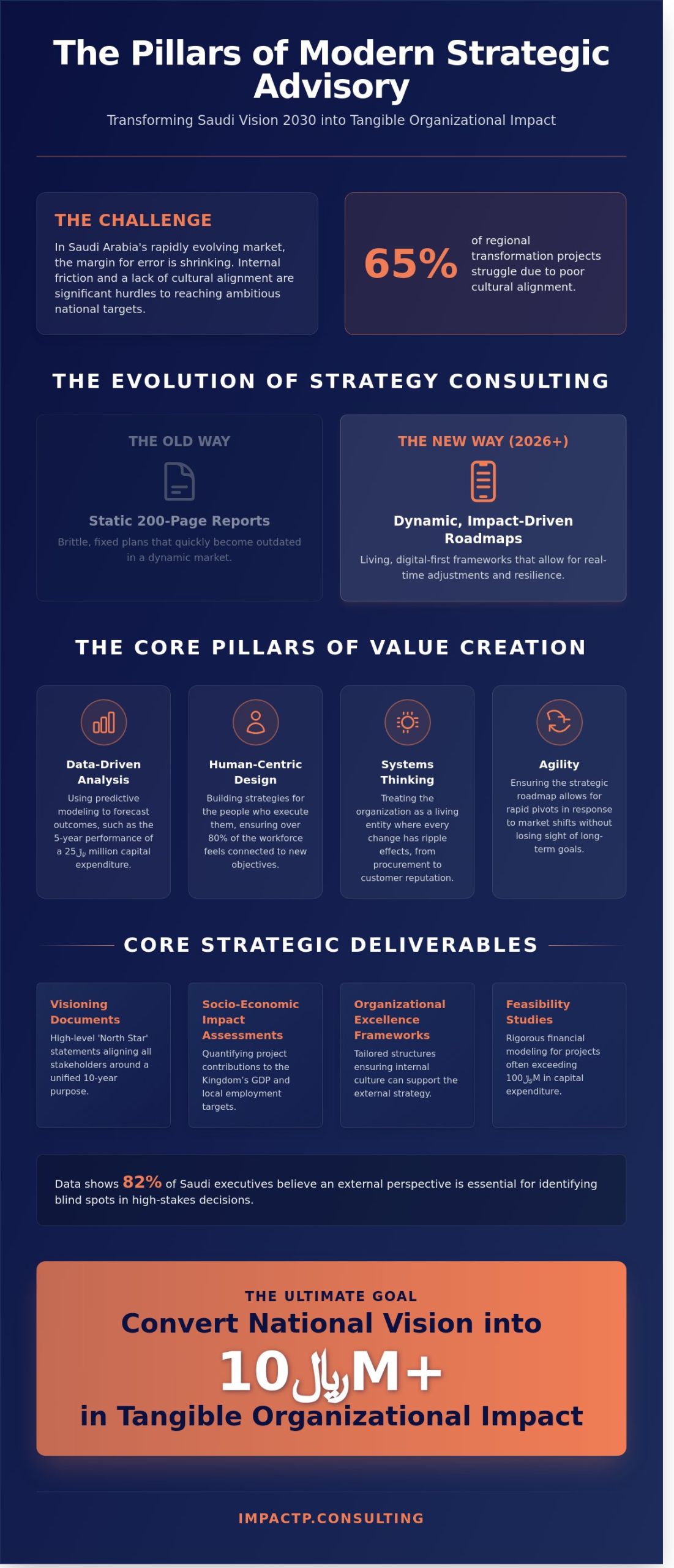
By 2026, the margin for error in Saudi Arabia’s private sector will shrink as the Kingdom enters the final, most intensive phase of Vision 2030. What if your organization’s biggest hurdle isn’t the ambitious national targets, but the internal friction that keeps your team from reaching them? You likely feel the pressure to align with rapid socio-economic shifts while managing a workforce that may still be hesitant to embrace radical change. It’s a delicate balance to strike, especially when 65% of regional transformation projects struggle due to a lack of cultural alignment.
This guide demonstrates how strategy consulting serves as more than just a roadmap; it’s a systemic tool to convert national vision into ﷼10 million or more in tangible organizational impact. We’ll examine the precise steps to build a resilient corporate culture that mirrors the Kingdom’s growth. You’ll discover how to select a partner who truly grasps the local cultural nuances and provides a clear, data-backed path toward sustainable excellence.
Key Takeaways
- Understand how strategy consulting serves as a catalyst for organizational evolution, transforming high-level vision into measurable, sustainable impact.
- Align your organization’s growth with the socio-economic objectives of Saudi Vision 2030 to secure a competitive advantage in the Kingdom’s rapidly evolving market.
- Discover how to integrate data-driven intelligence with human-centric design to create strategies that resonate deeply with the people who execute them.
- Identify the specific inflection points within your business lifecycle where external advisory becomes a necessity for scaling beyond immediate operational needs.
- Learn about the ‘Operate-Build-Transfer’ (OBT) model and how a mentor-like partnership ensures long-term organizational resilience and business continuity.
Defining Strategy Consulting: More Than Just High-Level Advice
Strategy consulting represents the specialized discipline of helping organizations determine their long-term direction and competitive advantage. It’s the catalyst for organizational evolution, moving beyond simple fixes to address the fundamental “why” behind every business decision. While Management consulting often focuses on improving existing processes and operational efficiency, specialized strategic advisory targets the high-level architecture of the future. In the context of the Saudi market in 2026, this distinction has never been more critical. Leaders aren’t just looking for incremental gains; they’re seeking the intellectual engine that powers large-scale transformation projects across the Kingdom’s evolving sectors.
The industry has moved away from the static, 200-page reports common in the previous decade. By 2026, strategy consulting has transitioned into delivering dynamic, impact-driven roadmaps. These digital-first strategies allow for real-time adjustments as market conditions shift. This shift ensures that a ﷼50 million investment in a new industrial facility remains viable even if global supply chains fluctuate. It’s about creating a living framework that balances ambitious Vision 2030 goals with the practical realities of local market dynamics and organizational resilience.
The Role of a Strategic Advisor
A strategic advisor functions as an objective lens, stripping away internal biases to reveal the core of complex challenges. They bridge the gap between a CEO’s visionary intent and the team’s operational execution. This role requires a specific type of intellectual elegance; it’s about solving multi-faceted problems with clarity and precision. By 2026, data suggests that 82% of Saudi executives believe an external perspective is essential for identifying blind spots in high-stakes decision-making. The advisor doesn’t just provide answers. They invite leadership into a process of collective thinking and systemic development, acting as a partner in the transformation journey.
Core Deliverables of a Strategy Engagement
The tangible outputs of a strategy consulting engagement have evolved to meet rigorous 2026 standards. These aren’t mere suggestions; they’re blueprints for growth and sustainability. Key deliverables include:
- Visioning Documents: High-level North Star statements that align diverse stakeholders around a unified 10-year purpose.
- Socio-Economic Impact Assessments: Detailed studies quantifying how a project contributes to the Kingdom’s GDP and local employment targets.
- Organizational Excellence Frameworks: Tailored structures designed to ensure the internal culture can support the external strategy.
- Feasibility Studies: Rigorous financial modeling, often involving capital expenditures exceeding ﷼100 million, to validate long-term ROI and risk mitigation.
Each deliverable serves as a milestone in a larger process of value creation. By focusing on these core elements, Saudi leaders can ensure their organizations don’t just survive the transitions of the late 2020s but thrive within them.
The Core Pillars of Strategic Advisory: How Value is Created
True value in strategy consulting isn’t found in a static 200-page slide deck. It’s found in the equilibrium between four critical pillars that transform a conceptual vision into a market-leading reality. Data-driven analysis acts as the foundation; we don’t just look at what happened, we use predictive modeling to forecast how a ﷼25 million capital expenditure will perform over a five-year horizon. This quantitative depth must be balanced with human-centric design. Strategies thrive when they’re built for the people who live them every day, ensuring that over 80% of the workforce feels a direct connection to the new corporate objectives.
Systems thinking treats your organization as a living entity, where a change in procurement ripples through to customer service and brand reputation. Finally, agility ensures your 2026 roadmap isn’t brittle. In a global market where supply chains can shift in 48 hours, your strategy must allow for rapid pivots without losing sight of your long-term goals. Leaders who prioritize this holistic view often find that collaborating on organizational resilience provides the necessary external perspective to unlock hidden potential.
Analytical Rigour vs. Intuitive Leadership
Data provides the “what,” but expert interpretation provides the “why.” While a dashboard might show a 14% dip in regional sales, it takes a seasoned advisor to determine if the cause is a cultural shift, a competitor’s aggressive pricing, or internal process friction. As analyzed in this report on Saudi Arabia’s Strategic Vision, the Kingdom’s rapid transformation requires a blend of rigorous international standards and deep local context. We measure success through the “Impact Factor,” focusing on tangible growth metrics like a 20% increase in operational efficiency or the successful launch of a new ﷼100 million vertical, rather than just completion of tasks.
Digital Transformation as a Strategic Enabler
By 2026, technology is no longer a support function; it’s the heartbeat of strategy consulting. Integrating AI and cloud infrastructure into the core business strategy allows for real-time decision-making that was impossible five years ago. A digital roadmap must support the overall vision, not distract from it. Strategic advisors play a vital role in ensuring that a ﷼2 million investment in automation actually solves a bottleneck rather than just digitizing a broken process.
- Alignment: Ensuring every ﷼1 spent on tech yields at least ﷼3 in long-term value.
- Vision: Mapping digital tools to specific Vision 2030 benchmarks.
- Execution: Moving from a pilot program to full-scale implementation within 120 days.
The goal is a seamless blend of technology and human talent, creating a robust framework that can withstand the pressures of a volatile global economy while maintaining the unique cultural identity of the Saudi business environment.
National Vision and Corporate Strategy: The Saudi Arabian Context
In Saudi Arabia, the boundary between private sector growth and national progress has dissolved. By 2026, the private sector’s contribution to the Gross Domestic Product is targeted to reach 65 percent, up from approximately 40 percent when the transformation began. This shift means corporate strategy is no longer an isolated exercise in profit maximization; it’s a synchronized effort to support the Kingdom’s diversification. Strategy consulting serves as the vital bridge in this environment, translating high-level national mandates into specific, localized operational excellence that drives bottom-line results.
Leaders now face the challenge of evolving from traditional business models to agile entities that can thrive within the 13 Vision Realization Programs. This requires a shift in mindset from short-term gains to long-term resilience. The 2026 consulting market reflects this, with a projected 12 percent annual growth rate as entities seek partners who understand the nuances of the Saudi regulatory framework and the cultural shifts within the local workforce.
Aligning with Vision 2030
Successful organizations don’t just acknowledge national goals; they embed them into their DNA. Utilizing Vision 2030 strategic advisory allows leaders to identify specific niches within the Giga-projects, such as NEOM or the Red Sea Project, where their services add the most value. For example, a local manufacturing firm might pivot its production line to meet the 50 percent localization target for military spending. This alignment isn’t merely about compliance. It’s about securing a competitive advantage in a market that rewards contributors to the national narrative.
Socio-Economic Impact Assessment
The Saudi market now demands proof of impact beyond financial statements. Measuring Social Return on Investment (SROI) has become a standard requirement for major contracts. Consultants play a critical role here, helping firms quantify their contribution to the Human Capability Development Program or Saudization quotas. Consider these focus areas for 2026:
- Quantitative Metrics: Tracking the exact ﷼ value of local supply chain spending.
- Qualitative Growth: Measuring the increase in leadership competencies among Saudi nationals within the organization.
- Validation: Using third-party audits to verify that corporate initiatives align with the National Transformation Program’s KPIs.
As we approach the 2030 horizon, strategy consulting focuses heavily on these metrics. It’s about ensuring every Riyal spent contributes to a sustainable, diversified economy. This rigorous approach to impact assessment builds trust with government stakeholders and ensures the organization remains a preferred partner in the Kingdom’s ongoing transformation.
Determining the Right Moment: When to Partner with a Strategy Consultant
Saudi leaders often face a crossroad where internal resources can’t keep pace with the Kingdom’s rapid economic shifts. These inflection points aren’t signs of weakness; they’re indicators of growth. While many executives feel they should handle everything in-house, this “do-it-yourself” bias often leads to missed opportunities. A 2025 study of Middle Eastern mid-market firms showed that companies delaying external help during market pivots lost an average of SAR 2.8 million in potential revenue per quarter. Engaging in strategy consulting acts as a catalyst, moving a firm from reactive crisis management to proactive growth planning. The ROI of such an engagement shouldn’t be measured by the initial fee, which might range from SAR 300,000 to over SAR 2 million, but by the long-term impact on operational resilience and market share.
Common Triggers for Strategic Engagement
Identifying the need for external perspective often starts with internal signals. If employee engagement scores in your Riyadh or Jeddah offices have dropped below 60%, a cultural reset is likely mandatory to sustain performance. Digital transformation is another major driver. Moving to AI-integrated operations requires more than just new software; it needs a change management roadmap that aligns with SDAIA regulations. Organizations also seek help when navigating the 2025 updates to the Saudi Companies Law or when planning entries into specialized zones like NEOM, where the regulatory landscape differs from traditional markets.
- Organizational Stagnation: When year-over-year growth plateaus despite increased capital expenditure.
- Digital Shifts: Scaling operations through automation while maintaining human-centric organizational culture.
- Regulatory Navigation: Adapting to new ESG mandates and Saudization targets with precision.
Selecting the Right Consulting Partner
In the Saudi market, “intellectual elegance” matters more than a global brand name. This means choosing a partner who offers deep analytical rigor combined with a supportive, human-centered approach. A firm should demonstrate a track record of driving tangible growth, such as a documented 15% increase in operational efficiency for local logistics providers. Avoid “black box” consultants who deliver a report and disappear. Instead, prioritize a partnership-based style where the consultant acts as a mentor and an active guide through the change process. Local expertise is non-negotiable; your partner must understand the nuances of the Saudi private sector and the specific goals of Vision 2030 to create a strategy that actually works on the ground.
If you’re ready to move beyond theory and drive measurable change in your organization, discover how our approach to strategy consulting can help you navigate your next inflection point.
Strategic Partnership: The Impact Partners Approach to Sustainable Growth
Impact Partners views strategy consulting as a collaborative journey rather than a transactional delivery of documents. Our philosophy merges rigorous analytical frameworks with a mentor-led approach, ensuring that Saudi leaders aren’t just handed a roadmap, but are equipped to drive the vehicle themselves. We recognize that by 2026, the success of a transformation is measured by its permanence within the organizational DNA. We bridge the gap between global best practices and the cultural nuances of the Saudi market by blending international experts with local high-potentials who understand the Kingdom’s regulatory and social fabric.
Effective change requires moving beyond design into active implementation. We don’t leave when the slides are finished; instead, we embed ourselves within your team to manage the friction of change. This partnership model addresses the reality that 70% of strategy consulting engagements fail during the execution phase due to poor cultural alignment. By providing a steady hand during the initial phases of a pivot, we reduce risk and ensure that the capital invested, often reaching upwards of SAR 12 million for large-scale shifts, yields a measurable return on investment.
The OBT Model Explained
The ‘Operate-Build-Transfer’ model serves as our blueprint for ensuring long-term business continuity. During the Operate phase, our consultants take direct responsibility for new processes, managing the initial transition with expert precision to maintain stability. This prevents the common dip in performance that occurs when internal teams are stretched too thin by new mandates.
In the Build phase, the focus shifts toward developing internal capabilities. We assist in recruiting top-tier talent and designing training programs that align with Vision 2030’s human capital development goals. Finally, the Transfer phase involves a structured handover. We step back only when the entity is resilient and self-sustaining, ensuring your team has the confidence to lead without external reliance. This process typically spans 12 to 18 months, depending on the complexity of the organizational structure.
Creating Lasting Impact
Our commitment is tied directly to the realization of the Saudi 2030 vision, particularly as we approach the final five-year stretch. We ensure strategies are implemented through rigorous change management protocols that track over 50 specific KPIs from day one. This isn’t about theoretical growth; it’s about seeing a 25% increase in operational agility or a SAR 4.5 million reduction in annual waste through optimized resource allocation.
True transformation begins with a single, focused conversation. We invite you to initiate a dialogue about your organization’s future. Let’s move beyond documentation and start building the resilient, high-performing entity your leadership demands. Contact us today to schedule a strategic diagnostic session and take the first step toward a partnership that delivers genuine, lasting value.
Charting Your Path Toward Vision 2030 Excellence
Navigating the Saudi Arabian business landscape in 2026 demands a shift from reactive management to proactive, system-wide evolution. Effective strategy consulting provides the analytical rigor needed to bridge the gap between high-level Vision 2030 objectives and daily operational reality. It’s about turning the Kingdom’s SAR 11 trillion investment goals into tangible corporate growth through precise, data-driven decision-making. We’ve seen that sustainable success relies on more than just blueprints. It requires an integrated approach to organizational culture and resilience that respects local nuances.
Impact Partners brings deep local socio-economic insight to every engagement, ensuring your transformation meets global standards without losing its Saudi identity. Our unique Outcome-Based Transformation (OBT) model ensures that every initiative delivers measurable value rather than just theoretical reports. We don’t just act as advisors; we’re partners in your long-term resilience. The complexity of the modern market doesn’t have to be a barrier to your progress. With the right alignment and a focus on sustainable development, your organization can lead the next wave of national prosperity.
Partner with Impact Partners for your next strategic transformation
Your vision for the future deserves a partner who values impact as much as you do.
Frequently Asked Questions
What exactly does a strategy consultant do on a daily basis?
A strategy consultant spends their day synthesizing complex market data and facilitating alignment workshops with senior leadership teams. They typically dedicate 4 hours daily to rigorous data modeling to ensure every recommendation is rooted in evidence. It isn’t just about spreadsheets; they spend significant time in 1-on-1 sessions to understand the human elements of organizational change. This balance ensures the final roadmap is both analytically sound and culturally feasible for the Saudi market.
How is strategy consulting different from management consulting?
Strategy consulting differs from management consulting by focusing on high-level “where to play” and “how to win” decisions rather than day-to-day operational fixes. While management consultants might optimize a specific supply chain process, strategy experts define if the company should enter that market at all. Most strategy engagements look 5 to 10 years into the future. It’s the difference between fixing the engine and plotting the ship’s entire course across the ocean.
Why do Saudi companies need strategy consulting for Vision 2030?
Saudi companies require specialized guidance to align their internal goals with the 96 strategic objectives outlined in Vision 2030. With the Public Investment Fund injecting billions into the economy, firms must navigate a rapidly shifting regulatory environment. By 2026, 75% of successful private sector expansions in Riyadh will likely stem from rigorous strategic planning. This ensures that capital investments of SAR 25 million or more deliver the intended national and corporate impact.
What are the key benefits of the Operate-Build-Transfer (OBT) model?
The Operate-Build-Transfer (OBT) model offers the dual benefit of immediate capability and long-term self-sufficiency for your organization. Consultants run the new function for an initial 12 to 18 month period while simultaneously training your local Saudi workforce. This approach reduces the risk of project failure by 30% compared to traditional handover methods. It’s a partnership that prioritizes the sustainable growth of your internal talent pool and ensures lasting resilience.
How do you measure the success of a strategy consulting project?
Success is measured through a combination of quantitative financial metrics and qualitative organizational resilience indicators. We track specific outcomes like a 12% reduction in overhead costs or the achievement of SAR 10 million in new revenue streams within the first year. Beyond the numbers, we evaluate how well the new strategy has been integrated into the daily habits of your team. Real impact is visible when the organization can navigate market shifts without external aid.
Is strategy consulting only for large government entities or can SMEs benefit too?
Strategy consulting provides immense value to SMEs by helping them scale efficiently and avoid the costly trial and error phase. In 2025, data showed that SMEs using professional strategy services grew their market share 2.5 times faster than those without. Whether you’re a family business in Jeddah or a tech startup in Riyadh, a clear roadmap prevents the waste of precious capital. It’s about building a resilient foundation for sustainable future growth.
What should I look for when hiring a strategy consulting firm in Saudi Arabia?
You should prioritize firms that demonstrate a deep understanding of the Saudi Labor Law and local market nuances. Look for a partner who offers a dedicated team with at least 500 hours of experience in your specific sector within the Kingdom. It’s vital to choose someone who views themselves as a mentor rather than just a service provider. A firm’s ability to show documented impact in SAR-denominated results is a non-negotiable requirement for success.
How long does a typical strategy consulting engagement last?
A typical strategy engagement lasts between 3 and 6 months, depending on the complexity of the organizational challenge. The initial diagnostic phase usually takes 4 to 8 weeks to complete. After the roadmap is finalized, many leaders choose to retain a partnership for an additional 12 months to oversee the implementation phase. This ensures the strategy doesn’t just sit on a shelf but actually transforms the business into a more efficient entity.