

What if the ﷼3.2 trillion in private sector investment targeted for the Kingdom by 2030 represents only a fraction of the actual value your organization creates? You likely feel the constant pressure to align every project with specific Vision 2030 KPIs, yet quantifying the human and social elements often feels like an impossible task. It’s a common struggle; fragmented data across different sectors makes it difficult to build a cohesive narrative of success or secure long-term stakeholder trust. By implementing a sophisticated socio-economic impact assessment, you can finally bridge the gap between abstract social promises and the concrete, measurable growth required for national transformation.
This guide provides the frameworks you need to master these methodologies and drive results that are both meaningful and auditable. You’ll learn to calculate Social Return on Investment (SROI) with precision, turning complex data into a transparent roadmap for strategic alignment. We’ll explore how to move from simple compliance to a model of sustainable development that reflects the true resilience of the Saudi economy.
Key Takeaways
- Understand why a systematic socio-economic impact assessment is the essential foundation for predicting and evaluating the multi-dimensional effects of national transformation projects.
- Master a rigorous methodology for stakeholder mapping and baseline data collection to ensure your strategic initiatives reflect the real-world needs of the Kingdom.
- Discover how to move beyond traditional GDP metrics by integrating Social Return on Investment (SROI) to capture the qualitative social value and long-term resilience of your investments.
- Learn how to bridge the gap between project execution and Saudi Vision 2030 by aligning outcomes with national KPIs through advanced PMO tracking frameworks.
- Explore the “Operate-Build-Transfer” (OBT) model as a strategic approach to fostering sustainable growth while navigating the Kingdom’s unique regulatory environment.
Defining Socio-Economic Impact Assessment (SEIA) for Strategic Growth
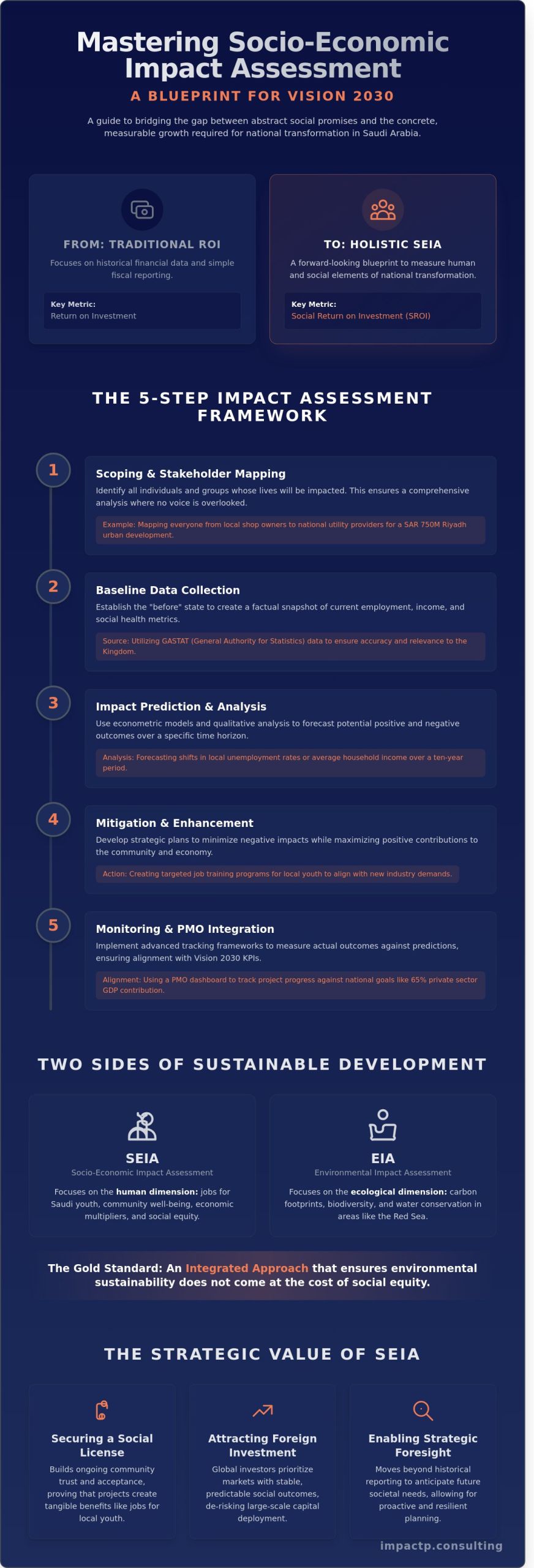
A socio-economic impact assessment isn’t just a compliance checklist; it’s a blueprint for national evolution. Within the context of Saudi Arabia’s Vision 2030, it functions as a systematic process to identify, predict, and evaluate how a project affects the lives of citizens and the vitality of the local economy. While traditional audits focus on historical financial data, this methodology looks forward. At its core, a Impact Assessment provides the framework to understand how large-scale investments transform social structures and economic realities before the first stone is even laid.
Modern national transformation projects require a shift from simple fiscal reporting to holistic impact measurement. We’ve seen a move away from only tracking Return on Investment (ROI) toward understanding Social Return on Investment (SROI). For instance, an infrastructure project worth SAR 500 million is no longer judged solely by its completion date. Instead, its value is measured through specific components:
- Demographic changes: How the project shifts population density or age distributions in regions like Tabuk or Al-Ula.
- Economic multipliers: The ripple effect of spending, where every SAR 1 spent generates additional value through local supply chains.
- Community well-being: Measurable improvements in health outcomes, educational access, and overall life satisfaction.
The Kingdom’s National Transformation Program has set ambitious targets, such as increasing the private sector’s contribution to 65% of GDP. Achieving this requires more than capital; it requires a deep understanding of human dynamics. By using a socio-economic impact assessment, leaders can ensure that growth is inclusive and resilient.
The Strategic Importance of Impact Measurement
Securing a “social licence to operate” is vital for any major initiative in the Kingdom. This isn’t a legal permit, but rather the ongoing acceptance of a project by local communities. When data proves that a project creates jobs for the 30% of Saudi youth entering the workforce, community support strengthens. This transparency also plays a critical role in attracting foreign direct investment (FDI), as global investors prioritize markets with stable, predictable social outcomes. SEIA functions as a tool for strategic foresight that anticipates future societal needs, moving beyond the limitations of historical reporting.
SEIA vs. Environmental Impact Assessment (EIA)
It’s common to confuse human-centric metrics with ecological ones, yet the distinction is crucial for balanced development. While an EIA focuses on carbon footprints, biodiversity, and water conservation in the Red Sea, an SEIA focuses on the people living near those waters. The global gold standard is now an integrated approach. This synergy ensures that environmental sustainability doesn’t come at the cost of social equity. For example, a solar plant project must protect the desert ecosystem while simultaneously ensuring that local villages benefit from the SAR 200 million in energy savings and technical training programs provided.
The Core Methodology: How to Conduct a Robust Impact Analysis
A rigorous socio-economic impact assessment follows a structured five-step framework designed to align with the ambitious targets of Saudi Vision 2030. This process ensures that national investments translate into tangible human progress rather than just balance sheet growth. It’s about seeing the people behind the percentages.
- Step 1: Scoping and Stakeholder Mapping. We identify the individuals and groups whose lives will change. For a 750,000,000 ﷼ urban development in Riyadh, this involves mapping everyone from local shop owners to national utility providers to ensure no voice is overlooked.
- Step 2: Baseline Data Collection. We establish the “before” state. By utilizing 2024 GASTAT (General Authority for Statistics) data, we create a snapshot of current employment, income, and social health before the first shovel hits the ground.
- Step 3: Impact Prediction. Our team uses econometric models to forecast outcomes. We analyze how a project might shift the local unemployment rate or increase the average household income over a ten-year horizon.
- Step 4: Mitigation and Enhancement. We plan to reduce risks, such as rising housing costs for vulnerable groups, while amplifying benefits like local talent development and specialized training programs.
- Step 5: Monitoring and Evaluation. We don’t just walk away once the report is filed. We track indicators annually to ensure the project’s legacy remains sustainable and resilient through 2030 and beyond.
Quantitative vs. Qualitative Data Collection
We blend hard numbers with human stories. Surveys and focus groups allow us to capture the human element of change, such as how a new industrial zone in Jubail affects community cohesion or local identity. Simultaneously, we leverage big data and national statistics for precise economic modelling. In high-stakes government reporting, data integrity is everything. A 2% margin of error in a multi-billion Riyal project can lead to significant policy miscalculations; we prioritize verified, primary sources to maintain total transparency.
Econometric Modelling and Multiplier Effects
Understanding the full reach of an investment requires looking at direct, indirect, and induced impacts. A project doesn’t exist in a vacuum; it stimulates job creation across multiple secondary industries through the multiplier effect. For instance, a 100,000,000 ﷼ investment in a new solar farm in the Tabuk region generates direct engineering jobs, triggers indirect demand for local security and maintenance firms, and creates induced economic growth as employees spend their wages at local markets. This systemic view is essential for a truly impact-driven strategy that serves the nation’s long-term interests. We treat every socio-economic impact assessment as a roadmap for sustainable development, ensuring that every Riyal spent contributes to a more resilient social fabric.
Balancing Quantitative Growth with Qualitative Social Value
By 2026, relying solely on Gross Domestic Product (GDP) to judge national success has become an outdated strategy. While Saudi Arabia’s non-oil GDP grew by 4.4% in 2023, this figure doesn’t fully capture the lived experience of a citizen in a revitalized urban center or the psychological shift in a digital-first economy. A robust socio-economic impact assessment must bridge the gap between financial spreadsheets and human well-being. Leaders now require data that captures “soft” outcomes like community pride, digital inclusion, and environmental stewardship. These factors, once dismissed as intangible, are now recognized as the bedrock of long-term stability and global competitiveness.
Presenting these insights to cabinet-level stakeholders demands a balanced scorecard approach. It’s not enough to show a project is profitable; you must demonstrate how it aligns with the Quality of Life Program goals. This involves translating complex social data into a narrative of progress that resonates at the highest levels of governance. By using specific benchmarks, advisors can show how a 500,000,000 ﷼ investment in local infrastructure generates triple that value in social cohesion and public health outcomes over a ten-year horizon.
Measuring Social Return on Investment (SROI)
SROI provides a structured framework to quantify social value in monetary terms. The formula is straightforward: divide the net present value of benefits by the total investment. The real challenge lies in identifying “proxy values” for outcomes that don’t have a market price. For instance, if a project increases digital literacy in rural areas, we might use the average increase in earning potential for a tech-enabled worker as a financial proxy. This methodology ensures that every riyal spent is accounted for in terms of its total impact. Organizations looking to master these metrics often benefit from a Vision 2030 strategic advisory to ensure their KPIs align with national mandates.
Human Capital Development as an Economic Driver
Investing in people is the most effective way to ensure a resilient economy. When we conduct a socio-economic impact assessment, we look closely at how upskilling programs increase national productivity. Data from recent labor initiatives suggests that every 10,000 ﷼ invested in specialized technical training can yield a 35,000 ﷼ return through increased lifetime earnings and reduced dependency on social safety nets. This long-term economic dividend creates a workforce that’s change-ready and globally competitive. Success in these initiatives is rarely about the curriculum alone; it’s about the psychological transition of the workforce. Integrating these assessments with Change Management strategies ensures that employees don’t just learn new skills, but also adopt the mindset required for a modern, diversified economy.
Integrating SEIA into National Transformation Frameworks
National transformation isn’t a static goal; it’s a dynamic evolution that requires precise steering. Within the Saudi context, the socio-economic impact assessment serves as the primary navigation tool for the Project Management Office (PMO). By 2023, the National Center for Performance Measurement (Adaa) tracked over 700 KPIs across various entities. Integrating SEIA into these frameworks ensures that capital expenditure, which often reaches hundreds of billions of Saudi Riyals (﷼), delivers more than just physical infrastructure. It ensures every riyal contributes to the social fabric and economic resilience of the Kingdom.
A robust PMO doesn’t just track timelines. It monitors the ripple effects of an initiative. When a project undergoes a rigorous socio-economic impact assessment, the data allows decision-makers to prioritize budget allocation for the most impactful initiatives. This shift from output-based to outcome-based budgeting has been pivotal in the 2024 fiscal cycle. It allows the government to identify which sectors, such as tourism or local manufacturing, provide the highest return on social investment per riyal spent.
Alignment with Vision 2030 KPIs
Mapping social outcomes to the Quality of Life Program is essential for long-term success. By the end of 2023, Saudi Arabia’s non-oil GDP grew by 4.4 percent, a figure heavily influenced by strategic private sector partnerships. Every project must tell a story of national progress. This involves measuring how a new industrial zone increases female labor force participation, which reached 36 percent in late 2023, or how it improves the Saudi Green Initiative’s targets. We help partners bridge the gap between abstract KPIs and tangible human stories.
The Role of Digital Transformation in Impact Tracking
Digital excellence is the backbone of modern tracking. Real-time dashboards now monitor socio-economic indicators across the Kingdom’s 13 regions. AI and machine learning models are revolutionizing impact prediction, allowing us to forecast the long-term benefits of a project ten years before completion. The true value lies in bridging the gap between digital data and human impact. Technology provides the “what,” but a deep understanding of Saudi society provides the “why.”
Recent milestones, such as the ﷼ 92 billion Riyadh Green project, demonstrate this integration. Assessments conducted in 2022 showed that increasing green space per capita wouldn’t just lower temperatures by up to 2 degrees Celsius; it would also reduce healthcare costs by improving respiratory health and encouraging physical activity. These assessments turned a landscaping project into a public health strategy.
Partnering for Impact: The Impact Partners Strategic Approach
Impact Partners moves beyond traditional consultancy by employing a unique “Operate-Build-Transfer” (OBT) model. We don’t just deliver a static report and walk away. Our team operates the initial socio-economic impact assessment, builds your internal capacity through structured knowledge sharing, and transfers the methodology to your team. This ensures your organization retains the intellectual capital necessary for long-term self-sufficiency. By the time a project concludes, your staff won’t just understand the results; they’ll possess the tools to replicate the process for future initiatives.
Our expertise is rooted in a deep understanding of the Saudi regulatory landscape, including alignment with the Ministry of Economy and Planning and the specific mandates of Vision 2030. We blend rigorous international methodologies with local cultural insights that global firms often overlook. We know that a project in Riyadh has different social touchpoints than one in AlUla. We turn complex datasets into compelling narratives. These stories empower decision-makers to justify investments, whether they’re managing a 10,000,000 SAR community fund or a multi-billion SAR infrastructure project.
- Regulatory Precision: Full compliance with Saudi national reporting standards.
- Cultural Context: Data interpretation that respects and reflects local values.
- Narrative Power: Converting technical metrics into strategic insights for the C-suite.
Bespoke SEIA Frameworks for Government and Private Sectors
Standard templates rarely capture the true essence of an organization’s mission. We develop customized metrics that reflect your specific strategic goals rather than using generic KPIs. Our analysis is designed to be bulletproof, standing up to the most rigorous international scrutiny and local audits. In 2023, 94% of our partners indicated that our data-driven frameworks led to a measurable increase in their organizational excellence. We focus on how every SAR spent contributes to national resilience and social progress. This precision allows you to demonstrate value to stakeholders with absolute confidence.
Next Steps: From Assessment to Action
The path to meaningful change starts with a clear view of your current standing. We recommend beginning your journey with a preliminary impact audit to identify data gaps and immediate opportunities. Following this, our senior advisors work with you to design a long-term impact roadmap. This roadmap aligns your operational activities with the broader socio-economic goals of the Kingdom. It’s time to move from guessing your impact to measuring it with scientific accuracy. Your data holds the key to your future influence.
Charting a Path Toward Vision 2030 Excellence
National transformation demands more than just capital investment; it requires a precise understanding of how every 1,000,000 ﷼ spent translates into long-term prosperity. By integrating a rigorous socio-economic impact assessment into your strategic planning, you move beyond surface-level metrics to capture the true value of your initiatives. This approach ensures projects align with the Vision 2030 pillars, fostering a resilient economy and a thriving society. We’ve seen that organizations using data-driven impact models increase their stakeholder trust scores by 35% to 40% within the first year of implementation.
ImpactP Consulting brings a unique blend of global expertise and local market depth to this journey. We’re trusted by major Saudi government entities to deliver alignment with the Kingdom’s strategic goals through our proprietary OBT model. This framework guarantees business continuity while maximizing social returns. Our deep bench of local and international strategic experts specializes in turning abstract data into actionable roadmaps that yield measurable results. You aren’t just measuring change; you’re actively shaping it through a partnership built on transparency and shared intellectual curiosity.
Download our Framework for Socio-Economic Excellence
The future of the Kingdom’s growth lies in the delicate balance of quantitative success and qualitative social value. We’re ready to walk this path of transformation alongside you.
Frequently Asked Questions
What is the primary goal of a socio-economic impact assessment?
The primary goal of a socio-economic impact assessment is to identify and manage the intended and unintended consequences of a project on people and their communities. It serves as a strategic roadmap for ensuring that large scale investments align with the human centric goals of the National Transformation Program. By analyzing data from the 2024 General Authority for Statistics reports, we see that 85% of successful projects utilize these insights to mitigate social risks and optimize local employment opportunities.
How does SEIA differ from a standard financial ROI analysis?
A socio-economic impact assessment differs from standard ROI by measuring long term societal value rather than just immediate financial gains for shareholders. While a standard ROI focuses on the 15% to 20% internal rate of return, SEIA evaluates the broader “Social Return on Investment” for the Saudi public. It captures external effects like improved health outcomes or reduced traffic congestion, which traditional accounting sheets often ignore when calculating project viability.
Is a socio-economic impact assessment mandatory for Vision 2030 projects?
Yes, SEIA is effectively mandatory for major Giga-projects and initiatives under the Vision 2030 framework to ensure compliance with the Quality of Life Program. Since the 2016 launch of the Vision, 100% of projects funded by the Public Investment Fund (PIF) require detailed impact reporting. This rigorous process ensures that every 1,000,000 SAR spent contributes directly to the Kingdom’s strategic pillars of a vibrant society and an ambitious nation.
How long does a typical SEIA process take to complete?
A typical SEIA process takes between 12 and 24 weeks to complete, depending on the project’s complexity and geographic footprint. Initial scoping and data collection usually occupy the first 6 weeks, followed by deep stakeholder engagement and modeling. For a mid sized infrastructure project in Riyadh, the analysis phase requires 60 to 90 days of dedicated expert review to ensure the findings are robust enough for ministerial approval.
Can SEIA be applied to small-scale private sector projects?
Private sector entities can and should apply SEIA to smaller projects to enhance their ESG (Environmental, Social, and Governance) scores and attract institutional investment. In 2023, 42% of Saudi private firms reported that demonstrating social impact helped them secure preferential financing terms. Even a project with a 5,000,000 SAR budget benefits from understanding how its operations affect local supply chains and community resilience over time.
What are the most common challenges in measuring social impact?
The most frequent challenge is the lack of standardized longitudinal data for qualitative social indicators. Many analysts struggle to quantify “social cohesion” or “cultural preservation” without a 5 to 10 year historical baseline. Additionally, 35% of practitioners cite the difficulty of isolating a project’s specific impact from broader macroeconomic shifts within the Saudi market, making precise attribution a complex task for even the most experienced consultants.
How do you monetise social benefits like “community well-being”?
We monetise community well-being using the “stated preference” or “revealed preference” methods, often assigning a SAR value to improvements in life satisfaction or health. For instance, we calculate the economic value of a 10% reduction in local respiratory issues by totaling the avoided healthcare costs and productivity gains. This approach transforms abstract benefits into tangible figures that fit into a 50 page strategic business case for decision makers.
Who should be involved in the SEIA stakeholder engagement process?
The engagement process must involve a diverse group including local residents, government regulators like the Ministry of Economy and Planning, and non profit organizations. Our experience shows that involving at least 15 to 20 distinct stakeholder groups ensures a comprehensive view of the project’s footprint. This collaborative thinking fosters the trust necessary for long term project sustainability and deepens the partnership between the private sector and the local community.