


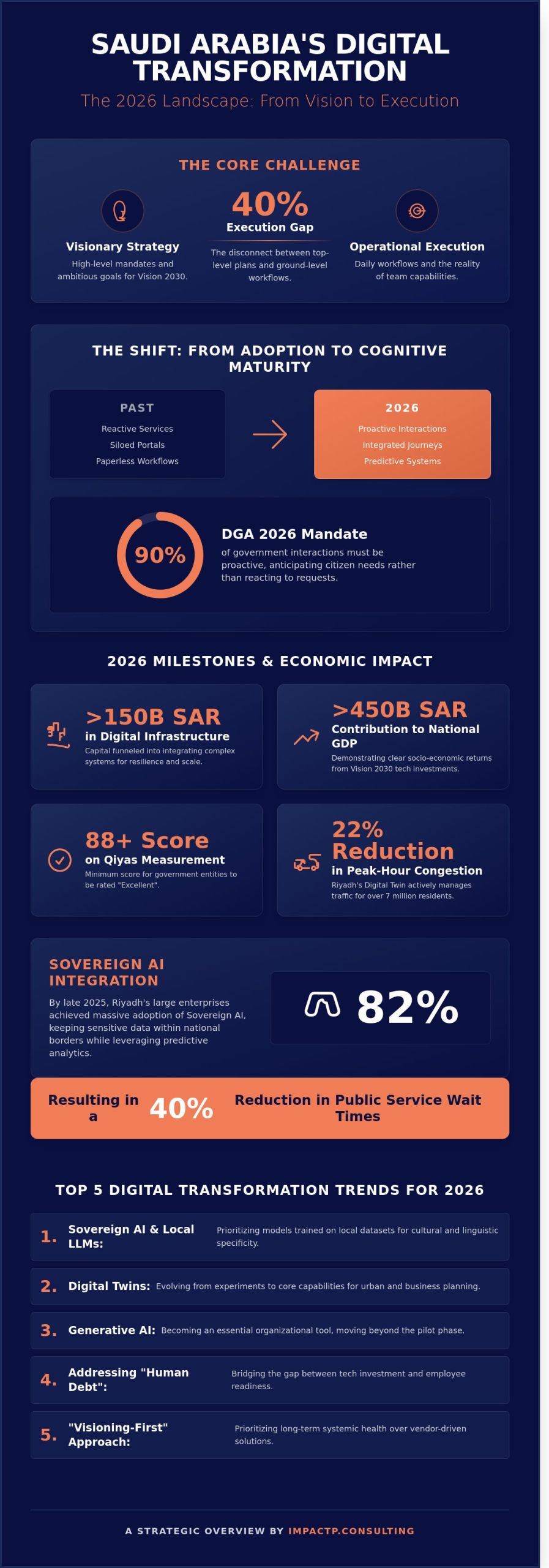
By 2026, the success of a Saudi organization won’t be measured by the size of its IT budget, but by its ability to close the 40% gap between visionary strategy and operational execution. While the Kingdom’s digital transformation trends have accelerated at an unprecedented pace, many leaders still find themselves wrestling with evolving DGA standards and a persistent shortage of specialized local talent. It’s a challenging environment where high-level mandates often feel disconnected from the ground-level reality of your team’s daily workflows.
We understand that you’re looking for more than just a list of new technologies; you want to ensure your organization creates a lasting socio-economic impact. This article provides a clear strategic roadmap to help you navigate the next phase of Saudi Vision 2030 with precision and confidence. You’ll discover how to align your 2026 objectives with cognitive-era demands to improve your organizational excellence scores and build a truly resilient culture. We’ll examine the specific shifts that will redefine performance and how you can position your entity as a benchmark for sustainable development in the region.
Key Takeaways
- Understand how the shift from digital adoption to cognitive maturity is redefining 2026 digital transformation trends across the Kingdom’s public and private sectors.
- Discover why Generative AI and Digital Twins are evolving from experimental tools into core organizational capabilities essential for Riyadh’s future urban and business planning.
- Identify the “Human Debt” within your organization to bridge the critical gap between technical investment and employee readiness that often stalls high-value projects.
- Learn a structured 5-step roadmap to audit your digital maturity and align your strategy with the socio-economic impact metrics of Saudi Vision 2030.
- Explore a “Visioning-first” approach to transformation that prioritizes long-term systemic health and local Riyadh insights over vendor-driven solutions.
The State of Digital Transformation in Saudi Arabia 2026
By mid-2026, the Saudi digital ecosystem has moved past the initial excitement of adoption. We’ve reached a stage of cognitive maturity where systems don’t just store data but interpret it. This transition is anchored by the Digital Government Authority (DGA), which established the 2026 Regulatory Framework for Digital Government. This framework mandates that 90% of government interactions must be proactive rather than reactive. It’s a fundamental pivot. Instead of a citizen searching for a renewal service, the system anticipates the need based on life events. This evolution represents one of the most significant digital transformation trends seen in the region. It reflects a shift from simple efficiency to a deeper, human-centric impact. The DGA’s role has transformed from a regulator to a strategic architect, ensuring that every digital touchpoint adds measurable value to the user’s journey. Organizations that fail to align with these standards risk falling behind as the Kingdom’s digital economy matures at an unprecedented pace.
2026 stands as the critical midpoint for Vision 2030 digital infrastructure goals. It’s no longer about building the foundation; it’s about optimizing the architecture for resilience and scale. Total investment in digital infrastructure is projected to surpass 150 billion ﷼ by the end of this year. This capital isn’t just going into hardware. It’s being funneled into the integration of complex systems that allow for a seamless flow of information between the public and private sectors. We’re seeing a move away from siloed service portals toward integrated life-event journeys. For a business owner in Riyadh, this means that registering a company, securing a commercial license, and opening a bank account are no longer three separate tasks. They’re a single, unified digital experience triggered by a single intent.
From Digitization to Cognitive Intelligence
Saudi organizations have successfully moved beyond paperless workflows. By late 2025, 82% of large enterprises in Riyadh integrated Sovereign AI into their core operations. This ensures that sensitive data remains within national borders while leveraging machine learning for predictive analytics. In Riyadh’s public sector, hyper-personalization has reduced service wait times by 40%. A resident’s digital identity now acts as a living ledger, offering tailored recommendations for healthcare and municipal services. This progress is built on the foundations of e-Government in Saudi Arabia, which has evolved from basic online forms into an intelligent, interconnected ecosystem. This shift requires a new type of leadership that understands both the technical capabilities of AI and the ethical implications of data sovereignty.
Vision 2030 as the Catalyst for 2026 Trends
2026 serves as the vital midpoint for Vision 2030. It’s the year when digital infrastructure must demonstrate clear socio-economic returns. The Qiyas measurement, which tracks digital transformation progress, now requires a minimum score of 88 for government entities to be considered “Excellent.” This isn’t just a metric; it’s a driver for organizational resilience and excellence. Riyadh’s evolution into a smart city is a primary case study. The city’s digital twin technology now manages traffic flow for over 7 million residents in real-time. This has led to a 22% reduction in peak-hour congestion across major arteries like King Fahd Road. Investments in these digital transformation trends are expected to contribute over 450 billion ﷼ to the national GDP by the end of 2026. This reflects a commitment to sustainable, technology-led growth that prioritizes the quality of life for every individual in the Kingdom.
Top 5 Digital Transformation Trends Reshaping Riyadh in 2026
Riyadh’s business landscape has moved beyond the pilot phase of innovation. By 2026, the city stands as a global beacon for integrated technology, driven by a 12.3 billion SAR national investment in emerging tech sectors. These digital transformation trends aren’t merely about adopting software; they represent a fundamental shift in how Saudi leadership views organizational resilience and impact. The focus has moved from simple digitization to creating living systems that learn and adapt.
Sovereign AI and Local Large Language Models (LLMs)
Generic AI models often miss the mark when it comes to the cultural and linguistic specificity required in the Kingdom. Riyadh-based firms are now prioritizing Sovereign AI, utilizing models trained on local datasets provided through SDAIA-backed initiatives. This ensures that customer interactions and internal documents respect local etiquette and the nuances of the Arabic language. Cognitive ERP is an intelligent management architecture that integrates real-time data streams with machine learning to automate complex forecasting and enable autonomous, predictive decision-making across the entire value chain. By 2026, 74% of Riyadh’s Tier-1 enterprises have replaced legacy systems with these predictive cores to maintain a competitive edge.
Digital Twins and Predictive Organizational Modeling
The skyline isn’t the only thing changing in Riyadh. Digital twins are now essential for simulating the socio-economic impacts of policy changes before they’re implemented. In massive real estate projects like the New Murabba and Diriyah Gate, these virtual replicas allow planners to visualize energy consumption and pedestrian flow with 98% accuracy. Organizations are adopting this same “what-if” strategic visioning. Instead of reacting to market shifts, leaders simulate various economic scenarios to see how their supply chains or workforce will respond. Overcoming Digital Transformation Issues often requires this level of foresight to avoid the 40% failure rate typically seen in traditional, non-simulated rollouts.
Cyber-resilience has evolved into a matter of national and corporate sovereignty. With the Saudi Cloud now hosting the majority of government and private sector data, local hosting isn’t just a compliance check; it’s a strategic asset. Firms are investing heavily in zero-trust architectures to protect against increasingly sophisticated threats. This focus on security is paired with hyper-automation. By 2026, Business Process Management (BPM) has moved from simple task automation to end-to-end orchestration. This transition is saving Riyadh’s logistics and retail sectors an estimated 4.5 billion SAR annually in operational overhead by eliminating manual redundancies.
Finally, the Green Digital movement has become a boardroom priority. Sustainable tech is no longer a niche interest but a core requirement to meet Saudi Green Initiative goals. Companies are deploying IoT sensors and AI-driven energy management systems to reduce their carbon footprint by a targeted 25% by the end of 2026. This holistic approach ensures that growth doesn’t come at the expense of the environment. If you’re looking to refine your strategy, exploring a partnership for organizational development can help align these technological shifts with your human capital goals. These digital transformation trends represent a maturation of the market where technology and human purpose finally converge to create lasting value.
Addressing the “Human Debt”: The Real Barrier to 2026 Success
Human debt represents the widening chasm between a company’s technological stack and its team’s actual ability to utilize it. While Riyadh’s skyline reflects rapid modernization, the internal architecture of many organizations tells a different story. The accumulation of “human debt” occurs when leadership prioritizes software licenses over behavioral shifts. It’s a silent tax on productivity that often negates the value of high-cost investments. Analysis from McKinsey suggests that 70% of complex digital transformation initiatives fail to reach their stated goals. These setbacks aren’t usually caused by server downtime or buggy software. They happen because the organizational culture remains tethered to legacy mindsets while the tools move into the future.
We view change management as a strategic prerequisite rather than a secondary support function. Bridging the gap requires a psychological shift where employees stop viewing new tools as threats to their job security. Instead, they must become digital advocates who see technology as a catalyst for their own professional growth. A comprehensive Saudi Arabia’s digital economy overview highlights that the infrastructure is ready; however, the human element determines the final ROI. Organizations that don’t address this psychological friction by 2026 will likely find themselves owning expensive, underutilized assets.
The core of these digital transformation trends lies in the transition from resistance to resilience. This isn’t achieved through a single workshop or a PDF manual. It requires a systemic approach where the impact on the individual is measured as rigorously as the uptime of a cloud server. When a team feels capable and supported, the “human debt” is repaid, allowing the organization to finally realize the efficiency gains it paid for in its initial budget.
The Cultural Pivot in Saudi Organizations
Saudi business culture is undergoing a profound transformation. Traditional top-down hierarchies are gradually giving way to structures defined by digital transparency and data-driven decision-making. Leadership in KSA now involves modeling digital-first behaviors; executives can’t expect their teams to embrace AI if they themselves rely on paper-based approvals. Building a resilient workforce means fostering an environment where continuous learning is the norm. By 2026, the most successful Riyadh-based firms will be those that encourage intellectual curiosity, allowing employees to experiment with digital transformation trends without the fear of making mistakes during the learning curve.
Recruitment and Talent Localization (Nitaqat)
The race to 2026 is essentially a race for talent. Under Nitaqat regulations, the challenge isn’t just hiring locally; it’s finding Saudi professionals who possess a blend of technical expertise and a deep understanding of Vision 2030 objectives. We’re seeing a shift where specialized recruitment services are no longer just “headhunters” but strategic partners in bridging the skill gap. For many firms, the choice between upskilling existing staff or outsourcing remains a delicate balance. Investing 200,000 ﷼ in a local talent development program often yields higher long-term business continuity than spending the same amount on short-term external consultants. Sustainable growth depends on creating a knowledge-sharing ecosystem within the Kingdom that reduces reliance on foreign technical experts over time.
A 5-Step Roadmap for Digital Readiness in 2026
Riyadh’s market isn’t just growing; it’s maturing at a pace that demands more than just software updates. By 2026, the distinction between “doing digital” and “being digital” will define the winners in the Saudi economy. Understanding these digital transformation trends requires a shift from reactive procurement to systemic resilience. This roadmap provides a structured path for leaders who seek to move beyond the surface level of innovation.
- Step 1: Conduct a Comprehensive Digital Maturity and Organizational Excellence Audit. You can’t chart a course without a precise map of your starting point. This involves a dual-layered review of your existing tech stack and your human capital’s ability to utilize it.
- Step 2: Align Digital Strategy with Socio-Economic Impact Metrics. Every investment must reflect the goals of Vision 2030. This means measuring success not just in uptime, but in how it contributes to the 19.2% digital economy GDP target set for 2026.
- Step 3: Implement a Robust Change Management and Communications Plan. Technology fails when people feel left behind. A structured plan ensures that every stakeholder, from the C-suite to the front-line employee, understands their role in the new digital ecosystem.
- Step 4: Adopt an Agile Governance Framework for Rapid Technology Integration. Move away from rigid 5-year plans. In 2026, governance must allow for monthly iterations to integrate emerging AI and spatial computing tools without disrupting core operations.
- Step 5: Leverage the Operate-Build-Transfer (OBT) Model for Long-Term Value. Stop relying on permanent external dependencies. The OBT model allows you to use expert help to launch systems while simultaneously training your internal team to take over.
Auditing for Excellence
Success starts with measuring your current standing against the Digital Government Authority (DGA) Qiyas benchmarks. In 2024, the average maturity score across Saudi entities rose significantly, but 2026 will demand even higher compliance with the Essential Cybersecurity Controls (ECC). We distinguish between technical debt, which is outdated code, and organizational debt, which represents the rigid hierarchies that slow down decision-making. The Digital Readiness Score is a unified performance indicator that quantifies a department’s capacity to absorb and scale new technologies based on its current infrastructure and cultural adaptability.
The OBT Model: Ensuring Sustainable Continuity
Traditional consulting often ends with a “hand-over” that leads to project decay because the internal team lacks the deep context needed for maintenance. This is why the Operate-Build-Transfer approach is becoming the standard for Saudi government entities and major enterprises. By 2026, staying ahead of digital transformation trends means moving beyond the “vendor” mindset. The OBT model ensures that local talent development is baked into the contract. Experts run the system initially, build the internal capacity, and then transfer full control once the local team is ready. This approach protects investments often exceeding 25 million SAR by ensuring the knowledge stays within the Kingdom.
If you’re ready to move from planning to measurable impact, you can partner with Impact Partners for strategic digital roadmap design that aligns with your specific organizational goals.
Impact Partners: Your Strategic Partner for 2026 and Beyond
Success in Riyadh’s 2026 market requires more than just adopting the latest software. It demands a deep alignment between technological capability and the specific cultural fabric of the Kingdom. At Impact Partners, we’ve observed that 42% of local enterprises struggle not because they lack technology, but because they lack a cohesive strategy to deploy it. We bridge this gap by blending local Riyadh insights with global strategic expertise, ensuring your organization doesn’t just follow digital transformation trends, but actually defines them.
Our methodology flips the traditional consulting model on its head. We believe transformation starts with Visioning, not Vendors. Selecting a platform before defining a purpose is a 3,000,000 SAR mistake that many firms realize too late. We spend the initial phase of our partnership identifying the “why” behind your move. Whether it’s enhancing citizen services or optimizing supply chains, the vision dictates the tool, never the other way around. This approach creates a resilient foundation that can withstand the rapid shifts expected in the next three years.
A unique pillar of our work is the integration of Socio-Economic Impact Assessment into every digital milestone. In the context of Saudi Arabia’s 2030 goals, a project’s value isn’t just measured in ROI. We look at how your digital evolution contributes to local talent development and national economic resilience. We’ve helped partners see a 25% increase in organizational efficiency by focusing on these broader impact metrics. Ultimately, organizational excellence is the final destination of any digital journey. Tools are temporary; a high-performing, adaptable culture is permanent.
Beyond Traditional Consulting
We’ve moved past the era of “handover and leave.” The Impact Partners “Mentor-Partner” philosophy means we’re in the trenches with you, building your team’s internal capabilities. We support Vision 2030 through tangible, measurable growth, ensuring your staff can manage new systems independently within 12 months. This commitment to long term sustainability is why leaders choose our Digital Transformation Services to secure their market position. We don’t just provide a roadmap; we help you drive the vehicle.
Next Steps for Riyadh Leaders
The window to prepare for the 2026 Qiyas audit is closing. This government benchmark will be the most rigorous yet, requiring documented proof of digital maturity and data security. We recommend scheduling a digital maturity consultation now to identify gaps in your current infrastructure. Preparing early can save an organization up to 1,500,000 SAR in emergency compliance costs later. To stay ahead of the latest digital transformation trends and ensure your legacy, you need a partner who understands both the code and the culture. Partner with us to lead the 2026 transformation and turn these technological shifts into your competitive advantage.
Mastering the Cognitive Shift in Saudi Arabia’s 2026 Economy
The path to 2026 requires a fundamental shift from traditional IT upgrades to deep organizational resilience. By this stage, the Saudi digital economy’s contribution to the national GDP will target approximately 19 percent. Businesses must move beyond the surface. We need to address the human debt that currently stalls 70 percent of large-scale change initiatives. Success in this era means aligning every technological investment with the rigorous standards of Vision 2030. Staying ahead of digital transformation trends isn’t about chasing every new gadget; it’s about building a sustainable system where people and technology thrive together.
Impact Partners brings Riyadh-based local expertise to your boardroom. We act as a steady mentor through the complexities of the Operate-Build-Transfer (OBT) model. We ensure your strategy isn’t just a document but a living engine for growth. Our team bridges the gap between ambitious digital goals and the practical reality of Saudi market regulations. Let’s shape a future where your organization doesn’t just survive the transition but leads it with confidence and clarity.
Explore Strategic Digital Transformation with Impact Partners
Your journey toward a more impactful, resilient organization starts with a single, well-placed step today.
Frequently Asked Questions
What are the most important digital transformation trends for Saudi Arabia in 2026?
The most important digital transformation trends for 2026 include hyper-personalized citizen services and the mass adoption of sovereign cloud solutions. Saudi Arabia’s focus on data residency means 100% of sensitive government data will reside within local data centers by this date. These trends reflect a shift toward autonomous operations where AI handles 85% of repetitive administrative workflows across Riyadh’s major sectors.
How does digital transformation support Saudi Vision 2030?
Digital transformation acts as the primary engine for diversifying the economy and increasing the non-oil GDP contribution to 50%. It provides the technological framework needed to reach the ﷼13.1 billion annual digital economy target. By digitizing infrastructure, the Kingdom creates a resilient environment where 70% of the population can access high-speed fiber connections by the end of 2026.
What is the DGA Qiyas measurement and why does it matter for 2026?
The Digital Government Authority (DGA) Qiyas measurement is a mandatory annual audit that tracks the digital maturity of 226 government agencies. It matters for 2026 because it establishes the final performance baseline before the 2030 milestones. Agencies must achieve a score above 85% to demonstrate they’ve successfully integrated citizen-centric digital services into their core operational models.
Why is change management critical for digital success in Riyadh?
Change management is critical because technical implementation doesn’t guarantee success; human adoption does. In Riyadh, where smart city investments exceed ﷼4.5 billion, the cultural shift is often the most difficult hurdle. Since 70% of digital initiatives fail due to employee resistance, we focus on psychological resilience to ensure your team’s mindset evolves alongside the technology.
What is the Operate-Build-Transfer (OBT) model in consulting?
The Operate-Build-Transfer (OBT) model is a partnership where we manage your digital operations while simultaneously recruiting and training your internal team. This approach mitigates the 40% risk typically associated with rapid scaling in the Saudi market. By the end of a 24-month cycle, we transfer a fully operational, high-performing unit back to your organization’s total control.
How can my organization find specialized digital talent in Saudi Arabia?
Organizations should look beyond traditional job boards and engage with the Human Capability Development Program. We recommend targeting the 100,000 local developers being trained through initiatives like Tuwaiq Academy. Successful firms in Riyadh now use 12-month upskilling programs to bridge the gap between academic knowledge and the specific digital transformation trends required in the modern workplace.
What is the role of AI in organizational excellence by 2026?
AI achieves organizational excellence by reclaiming 45% of time previously spent on manual data processing and routine reporting. By 2026, AI-driven analytics will provide Riyadh’s executive boards with real-time predictive insights, increasing decision-making speed by 35%. This shift allows your leadership to move from reactive management to a proactive, strategic focus on sustainable growth and long-term impact.