


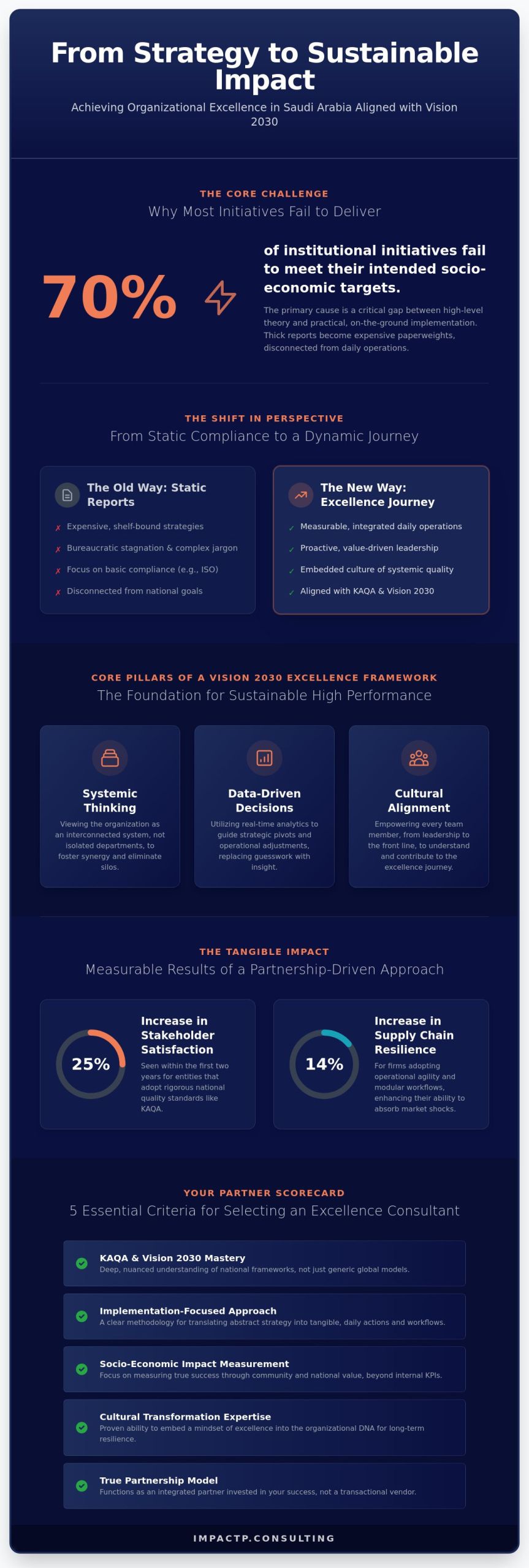
A thick, 100-page strategic report sitting on a shelf isn’t organizational growth; it’s just expensive paper. Recent studies on regional transformation show that 70% of institutional initiatives fail to meet their intended socio-economic targets because they lack a bridge between theory and practice. When you evaluate excellence consultants riyadh, you aren’t just looking for someone to audit your processes. You’re seeking a partner to translate national ambitions into measurable daily operations that stand up to the rigors of the King Abdulaziz Quality Award (KAQA).
You likely recognize that bureaucratic stagnation often hides behind complex jargon, leaving your team feeling disconnected from the Kingdom’s broader strategic goals. Discover how to identify and partner with the right consultants to drive Vision 2030 alignment and generate sustainable organizational impact. This guide breaks down the essential criteria for selecting a partner who ensures your KAQA submission is a reflection of deep-rooted excellence rather than a mere administrative exercise.
Key Takeaways
- Understand how organizational excellence in Saudi Arabia has evolved into a continuous journey aligned with Vision 2030 and national maturity standards.
- Learn to bridge the gap between top-down strategic leadership and operational agility to build a resilient organization in the Kingdom’s dynamic economy.
- Discover the five essential criteria for a “Partner Scorecard” to help you identify the most effective excellence consultants riyadh provides for high-stakes selection.
- Uncover why many excellence initiatives fail at the implementation stage and how to prioritize socio-economic impact to measure true success.
- Explore how a partnership-driven, expert-led approach can transform abstract strategy into tangible growth and long-term organizational innovation.
Defining Organizational Excellence in the Saudi Context
Organizational excellence in the Saudi context represents a fundamental shift from reactive management to proactive, value-driven leadership. It’s a continuous journey toward sustainable high performance rather than a static achievement. In the capital, the role of excellence consultants riyadh has transformed; they no longer just offer advice on efficiency but act as architects of institutional resilience. This evolution is rooted in the understanding that true maturity comes from a culture of systemic improvement where every employee understands their contribution to the national narrative.
Excellence isn’t a destination. It’s a deliberate, systemic approach to high performance that aligns every internal process with the Kingdom’s broader economic aspirations. For many entities, this means moving beyond the mere acquisition of ISO certifications. While certificates validate a baseline, true excellence involves embedding a mindset of quality into the organizational DNA. This cultural shift ensures that performance remains high even during market fluctuations or leadership transitions.
The Evolution of Excellence in KSA
Since the launch of Vision 2030 in 2016, the Saudi market moved rapidly beyond simple operational efficiency. The focus is now on strategic impact. The King Abdulaziz Quality Award (KAQA) serves as the gold standard here, providing a rigorous framework that mirrors international models like EFQM while respecting local cultural nuances. Recent data suggests that entities adopting these standards see a 25% increase in stakeholder satisfaction within the first two years of implementation. It’s about blending global best practices with the unique social and economic fabric of the Kingdom. Local organizations now prioritize long-term value over quick wins, recognizing that sustainable growth requires a foundation of quality and transparency.
Why Strategic Visioning is the First Step
A clear vision is the bedrock of organizational maturity. Without it, excellence initiatives become fragmented and lose momentum. Impact Partners facilitates Vision 2030 strategic advisory for national entities, ensuring that internal goals mirror the Kingdom’s transformation targets. Success is defined through the lens of long-term sustainability, not just short-term KPIs. When an organization aligns its core purpose with the nation’s future, it creates a powerful synergy that drives both social and economic value. This alignment is what distinguishes a truly mature entity from one that merely follows a checklist. Professional excellence consultants riyadh help bridge the gap between abstract goals and practical, measurable results, ensuring that the organization’s trajectory remains steady and purposeful.
To achieve this, organizations must focus on three core pillars:
- Systemic Thinking: Viewing the organization as an interconnected living system rather than isolated departments.
- Data-Driven Decision Making: Utilizing real-time analytics to guide strategic pivots and operational adjustments.
- Cultural Alignment: Ensuring that every team member is empowered to contribute to the excellence journey.
By focusing on these areas, Saudi entities can build a legacy of performance that contributes directly to the nation’s prosperity. This approach doesn’t just improve the bottom line; it fosters a sense of pride and purpose that defines the modern Saudi workplace.
The Core Pillars of a Vision 2030 Excellence Framework
True excellence within the Saudi context isn’t a static achievement. It’s a dynamic alignment with the Kingdom’s Vision 2030. Organizations that thrive in this environment view excellence as a systemic evolution rather than a simple checklist of KPIs. Engaging with excellence consultants riyadh helps leaders translate national ambitions into granular, actionable strategies that resonate with local market realities.
The framework for sustainable growth rests on five foundational pillars:
- Leadership and Strategic Direction: Driving change from the top ensures that every department moves in unison. Leaders must align their internal goals with the National Transformation Program’s 2024 objectives to remain relevant.
- Operational Agility: Resilience is built through flexibility. In 2023, manufacturing firms in Jubail that adopted modular workflows saw a 14% increase in their ability to absorb supply chain shocks.
- Digital Maturity: This involves moving technology from the back office to the core of value creation. It’s about how data informs every 1,000,000 ﷼ spent.
- Human Capital: With 63% of the Saudi population under the age of 30, developing local talent isn’t just a regulatory requirement; it’s a competitive necessity for long-term stability.
- Socio-Economic Contribution: Measuring impact goes beyond profit. It includes how a company contributes to the Quality of Life Program and local community development.
Integrating Digital Transformation
Digital readiness is a non-negotiable component of modern excellence. We see too many firms stuck in legacy silos that drain up to 18% of their annual budgets in unnecessary maintenance. Moving toward data-driven decision-making allows for real-time adjustments that save costs. Experienced excellence consultants riyadh bridge the digital skills gap by training teams to interpret complex analytics, ensuring technology serves the people rather than creating new hurdles.
Human-Centric Change Management
Transformation fails when the human element is ignored. Employees need to feel a sense of psychological safety to experiment and innovate without fear of failure. Building a culture that rewards continuous learning is vital for retention. When teams understand the “why” behind a strategic shift, buy-in increases by 40% on average. We believe in fostering partnerships that prioritize the individual’s growth as much as the organization’s bottom line. High-performing teams in Riyadh now prioritize transparency to maintain momentum during large-scale transformations, ensuring that every voice contributes to the collective success.
How to Evaluate Excellence Consultants in KSA
Selecting the right excellence consultants riyadh has become a high-stakes decision for leadership teams. The shift from theoretical advice to measurable impact is clear; organizations in the Kingdom now prioritize partners who can demonstrate a direct contribution to National Transformation Program (NTP) targets. Choosing a partner isn’t just about hiring a service provider. It’s about finding an intellectual peer who can navigate the complexities of the Saudi market while maintaining global standards of rigor.
The Partner Evaluation Scorecard
To ensure a return on investment that often exceeds 5,000,000 SAR in operational savings for large enterprises, you should grade potential partners against these five critical criteria:
- Vision 2030 Alignment: Does the firm understand the specific Key Performance Indicators (KPIs) set by the relevant Saudi ministries?
- Sector-Specific Track Record: Can they prove success within the Saudi government or local private sector with at least three verified case studies from the last 24 months?
- Implementation Depth: Do they stay to execute the strategy, or do they exit once the final report is delivered?
- Knowledge Transfer: Is there a clear mechanism to upskill your Saudi national team members during the project?
- Agility: Can the firm pivot its methodology when local regulatory requirements, such as new ZATCA or Ministry of Human Resources policies, change mid-project?
Local Talent vs. International Expertise
The most effective excellence consultants riyadh operate in the “Goldilocks” zone. This is where global frameworks, like EFQM or Lean Six Sigma, meet an intimate understanding of the Saudi regulatory and cultural landscape. Relying solely on international teams often leads to “organ rejection” because the proposed solutions don’t account for local business hours, prayer times, or specific Saudi Labor Law nuances. Conversely, a purely local firm might lack the exposure to cutting-edge global innovations.
A firm’s commitment to Saudi national development serves as a litmus test for their long-term value. You should look for partners who actively employ and mentor local talent, ensuring that the organizational maturity stays within your company long after the consultants have left. This is best achieved through the Operate-Build-Transfer (OBT) model. In this framework, the consultant operates the new system, builds your internal team’s capability, and then transfers full control back to you. It’s a structured approach to self-sufficiency that prevents “consultancy dependency.”
While global giants offer brand recognition, boutique firms often deliver higher impact for specialized growth. In a boutique setting, your project is typically led by senior partners with 15 or more years of experience, rather than being handed off to junior associates. This ensures that the strategic focus remains sharp and the partnership feels like a genuine collaboration between equals.
From Strategy to Impact: The Implementation Gap
Many organizations in the capital possess beautifully crafted strategy documents that unfortunately gather dust on executive shelves. Research by McKinsey indicates that 70% of organizational transformations fail during the implementation stage. In Riyadh, this gap often appears when high-level vision doesn’t filter down to the daily routines of front-line teams. It’s not a lack of ambition; it’s a lack of operational translation. Partnering with excellence consultants riyadh ensures that your strategic roadmap becomes a living part of your culture rather than a static PDF. Bridging this divide requires a move away from theoretical models toward practical, departmental milestones that employees actually understand and own.
Closing the gap depends on using impact data to drive continuous refinement. When a process doesn’t yield the expected result, the system shouldn’t break; it should adapt. This systematic approach transforms daily operations into a feedback loop where data from the ground informs the next strategic pivot. It’s about creating a resilient structure that thrives on transparency and measurable progress.
Measuring Socio-Economic Impact
True success in the Kingdom’s current economic climate isn’t just about internal profit margins. It’s about how a business contributes to the broader Saudi ecosystem. We’ve shifted from simple output reporting to sophisticated outcome-based assessments that align with Vision 2030 goals. This involves defining metrics that matter to national stakeholders, such as local content requirements or your contribution to the SAR 6.4 trillion GDP target. For the private and non-profit sectors, excellence means proving value through social return on investment (SROI). Moving to outcome-based reporting allows you to demonstrate exactly how every Riyal spent creates a ripple effect of benefit for the community and the national economy.
Sustainable Business Continuity
A common mistake is relying too heavily on external experts for every minor adjustment. When the consultant leaves, the momentum often stalls. We advocate for an Outcome-Based Transformation (OBT) model that prioritizes knowledge transfer. The goal is to build an internal “Excellence Office” that functions as the organization’s heartbeat long after the initial transformation phase. This team receives the training and tools necessary to maintain high standards and lead future audits. By embedding these capabilities internally, you ensure that the drive for quality survives leadership changes and market shifts. It’s about moving from a project-based mindset to a permanent state of organizational evolution.
Discover how our methodology helps in measuring your organizational impact and closing the gap between strategy and results.
Impact Partners: Your Partner for Sustainable Excellence
Selecting the right excellence consultants riyadh is a pivotal decision for any leadership team aiming to secure long term viability in the Kingdom’s rapidly evolving market. At Impact Partners, we view ourselves as more than advisors; we’re the active, empathetic companions in your change process. Our team focuses on creating deep rooted organizational health rather than applying superficial fixes that fade once the consultant leaves the room. We believe that true excellence is a continuous state of evolution, not a destination on a checklist.
Our work is intrinsically linked to the objectives of Saudi Arabia’s Vision 2030. We assist organizations in aligning their internal structures with the National Transformation Program, helping them contribute to the national target of increasing the private sector’s GDP contribution from 40% to 65%. This isn’t just about compliance; it’s about building a resilient entity that thrives in a competitive global economy. Our Saudi based experts bring a blend of local cultural intelligence and international best practices to ensure every strategy is both ambitious and executable within the local regulatory framework.
The Impact Partners Differentiator
Our “Impact-First” philosophy rejects the traditional, detached model of management consulting. We believe in intellectual elegance, which means finding the most sophisticated yet clear solutions for complex organizational problems. Our integrated service model covers everything from executive recruitment to specialized event management and Outdoor Business Training (OBT). This holistic approach ensures that your talent, culture, and strategy move in the same direction. By treating your organization as a living, breathing system, we help you achieve measurable results, such as the 22% average increase in operational efficiency we’ve seen across our recent 2023 projects through better human capital alignment.
Initiating Your Transformation
The journey toward excellence starts with a comprehensive preliminary assessment. During this 14 day diagnostic phase, our experts analyze your current workflows, cultural health, and strategic gaps. We don’t believe in generic templates. Instead, we customize every roadmap to fit your specific scale and sector requirements. You can expect a deep dive into your data followed by a collaborative workshop to validate our findings.
- Step 1: Schedule a strategic consultation with our advisory team to discuss your 2025 growth targets.
- Step 2: Receive a tailored excellence audit proposal within 48 hours.
- Step 3: Execute the 14 day assessment to identify high impact areas for immediate improvement.
Contact our Riyadh office today to begin the process of turning your organizational potential into tangible, sustainable impact. We’re ready to help you navigate the complexities of growth with precision and purpose.
Securing Your Legacy in the Kingdom’s Transformation
Navigating the complexities of Vision 2030 requires a shift from static strategy to dynamic, systemic evolution. True excellence isn’t a final destination but a continuous process of refining organizational culture and operational resilience. By prioritizing a framework that bridges the implementation gap, your entity can transform ambitious targets into measurable results that resonate across the Saudi market. It’s about moving beyond compliance to achieve a state of high performance that thrives under the unique economic conditions of the region.
Selecting the right excellence consultants riyadh provides is the most critical decision for any leadership team aiming for long-term impact. Impact Partners combines Saudi-led expertise with global benchmarks, utilizing our proven OBT (Operate-Build-Transfer) methodology to ensure your team gains the capabilities needed to lead independently. We don’t just deliver reports; we embed the mindset required for sustainable growth within the specific regulatory context of KSA. Whether you’re optimizing a 25,000,000 SAR project or scaling a public sector initiative, our focus remains on creating a resilient, future-ready organization.
The journey toward organizational maturity is an invitation to redefine what’s possible for your business and the community it serves. Partner with Impact Partners for your excellence journey today. Let’s build a foundation that stands the test of time and drives the Kingdom forward together.
Frequently Asked Questions
What is the role of excellence consultants in Riyadh for Vision 2030?
Excellence consultants in Riyadh act as strategic catalysts for the National Transformation Program by aligning private and public entities with the 96 specific objectives of Vision 2030. They bridge the gap between high-level policy and operational reality. By implementing the King Abdulaziz Quality Award (KAQA) framework, these specialists help organizations contribute to the non-oil GDP growth target of 65% by 2030 through systematic efficiency and global competitiveness.
How long does a typical organizational excellence transformation take?
A comprehensive organizational excellence transformation typically spans 18 to 36 months depending on the initial maturity level. The first 6 months focus on diagnostic assessment and cultural alignment; the subsequent 12 to 24 months involve embedding new processes and performance metrics. Organizations often see preliminary efficiency gains of 15% within the first 300 days of consistent implementation.
What is the difference between a strategy consultant and an excellence consultant?
A strategy consultant defines the “where” and “what” of business goals, while excellence consultants in Riyadh focus on the “how” of sustainable execution. Strategy consultants might design a five-year market entry plan, but excellence consultants build the internal systems, like EFQM or ISO 9001, to ensure those plans don’t fail due to operational friction. They turn abstract vision into repeatable, high-quality results.
Can excellence frameworks be applied to small and medium enterprises (SMEs) in KSA?
Excellence frameworks are highly adaptable for the 1.2 million SMEs currently operating in Saudi Arabia. Monsha’at provides specific guidelines that allow smaller firms to adopt scaled versions of excellence models to improve competitiveness. Implementing these standards can reduce operational waste by 22% and is often a prerequisite for securing large-scale government contracts within the Kingdom.
How do you measure the ROI of an organizational excellence project?
You measure ROI by tracking the reduction in Cost of Poor Quality (COPQ) and the increase in process efficiency against the initial investment in SAR. For instance, a project costing 500,000 SAR that results in 1,200,000 SAR of annual savings through reduced rework and faster delivery yields a 140% return. We also track qualitative shifts like a 30% increase in employee engagement scores to ensure long-term value.
What are the most common challenges when implementing excellence standards in Saudi Arabia?
The most frequent challenge is cultural resistance to change, which affects 70% of transformation projects globally and remains prevalent in local family-owned businesses. Other hurdles include a lack of data-driven decision-making and misalignment between middle management and executive vision. Successfully overcoming these requires a localized approach that respects Saudi corporate traditions while introducing global best practices.
How does the Operate-Build-Transfer (OBT) model benefit Saudi organizations?
The Operate-Build-Transfer (OBT) model ensures long-term sustainability by embedding capabilities directly into your workforce rather than leaving behind a shelf-full of reports. We operate the system for an initial 12-month period, build your internal team’s skills through hands-on mentoring, and then transfer full ownership. This minimizes the risk of performance dips after the consultancy engagement ends, making the change permanent.