


What if the 11 billion SAR spent annually on external expertise in the Kingdom is actually stalling your internal growth rather than accelerating it? By 2026, the Saudi consulting market is projected to exceed 15 billion SAR, but a 2023 industry review showed that 40% of transformation projects fail to achieve long term sustainability because they ignore local cultural nuances. You’ve likely felt the frustration of hiring consulting companies that deliver polished presentations but fail to provide the deep knowledge transfer your team needs to thrive independently. It’s a gap that often leaves leaders with high invoices and little measurable socio-economic impact.
We believe that true partnership isn’t about dependency; it’s about building organizational resilience together. This guide will show you how to evaluate potential partners through a lens of Vision 2030 alignment and sustainable excellence. You’ll discover a practical framework for choosing consultants who value your culture as much as your KPIs, ensuring your investment drives lasting change rather than temporary fixes.
Key Takeaways
- Understand the critical shift from theoretical strategy to hands-on implementation partnerships required to thrive in Riyadh’s evolving 2026 market.
- Learn how to evaluate consulting companies based on their commitment to building local Saudi talent and their measurable alignment with Vision 2030 milestones.
- Explore the comparative strengths of global giants versus local boutique firms to find the ideal balance of scale and socio-economic cultural depth.
- Discover how the Operate-Build-Transfer (OBT) model fosters organizational resilience and prevents the “knowledge vacuum” often left by traditional advisory firms.
- Identify the specific criteria for selecting partners who bridge the gap between abstract strategy and tangible, sustainable organizational impact.
The Evolution of Consulting Companies in Saudi Arabia (2026)
The landscape for consulting companies in Saudi Arabia has fundamentally shifted as we progress through 2026. Five years ago, a high-level strategy deck was often the final product of a multi-million riyal engagement. Today, that same deck is merely the invitation to a long-term implementation partnership. Clients in Riyadh and Jeddah no longer accept abstract theories; they demand tangible evidence of organizational resilience and sustainable growth. This evolution reflects a professional maturity where “Impact” isn’t a buzzword but a strictly measured KPI. Projects that once focused purely on financial ROI now integrate socio-economic metrics, reflecting a deeper commitment to the Kingdom’s future. The era of “PowerPoint consulting” has been replaced by a model where consultants stay on-site for 12 to 18 months to ensure every strategic pillar is actually built.
This shift toward execution requires a blend of global best practices and deep local nuance. It’s not enough to import a framework from London or New York and expect it to survive the cultural complexities of a Saudi state-owned enterprise. Success in 2026 depends on the consultant’s ability to act as a mentor and an analytical partner simultaneously. We’ve seen a rise in “embedded advisory,” where external experts work side-by-side with internal teams to transfer knowledge. This approach ensures that when the consultants eventually leave, the organization’s capability has actually improved. It’s a move away from dependency toward true empowerment.
The Vision 2030 Effect on Strategic Advisory
The overarching framework of Saudi Vision 2030 has rewritten the rules for every advisory engagement. Since the 2024 update to the National Transformation Program, roughly 75% of government tenders require a detailed “Local Content” plan. Consulting companies are now evaluated on how many Saudi consultants they mentor and how much intellectual property they localize. Every project must prove its alignment with national goals, whether it’s increasing female labor force participation to 35% or contributing to the ﷼1.7 trillion non-oil GDP target. Advisory firms act as the bridge between international standards and the specific socio-economic needs of the Saudi market, ensuring that every ﷼1,000,000 spent on consulting generates a measurable multiplier effect in the local economy.
Riyadh as the Global Hub for Management Consulting
Riyadh’s transformation into a global consulting powerhouse is no longer a projection; it’s a reality. Following the 2024 mandate for Regional Headquarters (RHQ), over 450 international firms established their primary Middle Eastern operations in the capital. This concentration of expertise has fostered a unique ecosystem. We’ve seen a 40% increase in boutique firms that specialize in high-touch, localized services. Proximity to decision-makers in the King Abdullah Financial District (KAFD) and the Digital City is vital. In 2026, the most successful partnerships happen through face-to-face collaboration. This physical presence allows consultants to sense the subtle shifts in organizational culture that remote teams simply miss. It’s about being an active, compassionate guide through the complexities of systemic change, ensuring that the human element of every transformation is never overlooked.
Global Giants vs. Boutique Riyadh Firms: A Comparison
Selecting between different consulting companies in Saudi Arabia involves more than just comparing logos or prestige. Since the 2016 launch of the national transformation program, the Kingdom’s professional services market has matured into a sophisticated ecosystem. Decision-makers now weigh the standardized, high-volume output of global “Big 4” and MBB (McKinsey, BCG, Bain) firms against the nuanced, high-touch approach of local boutique partners. While global giants bring massive data sets from London or New York, local impact-driven firms offer a deep resonance with the Saudi socio-economic fabric that external players often miss.
Global firms like Deloitte or McKinsey maintain a 15,000 SAR to 25,000 SAR daily rate for senior partners, providing a sense of security for massive institutional projects. However, the rise of specialized local firms has shifted the focus toward “impact partners” who treat a client’s organization as a living, evolving system rather than a series of billable hours. These local experts don’t just deliver slide decks; they act as active companions in the change process, ensuring that strategic goals align with the cultural realities of the Saudi workforce.
When to Choose a Global Firm
Global consulting companies remain the primary choice for large-scale, cross-border mergers and acquisitions where international legal frameworks are at play. If a project requires global benchmarking for international funding or a 100 million SAR operational audit across multiple continents, their infrastructure is unmatched. They provide the “safe” choice for boards that need to demonstrate alignment with global standards, often tracking progress via the official Vision 2030 website to ensure broad compliance with macro-economic targets.
The Boutique Advantage: Specialized Impact
Boutique firms in Riyadh offer a distinct edge through their deep understanding of local regulatory environments, such as ZATCA’s Phase 2 e-invoicing requirements or GOSI compliance. Instead of dealing with junior associates who are learning on the client’s time, organizations get direct, daily access to senior partners. This model fosters a culture of excellence where customized frameworks replace “copy-paste” solutions. It’s about creating a resilient organizational structure that respects Saudi traditions while embracing modern efficiency. For leaders seeking this level of focus, exploring how tailored organizational development can drive growth is a logical next step.
Agility has become the deciding factor for high-stakes contracts in 2024. Smaller firms often respond to critical pivots within 24 hours, whereas global giants may require weeks of internal approvals to change a project’s scope. This responsiveness is vital when navigating the rapid regulatory shifts currently defining the Saudi market. A boutique firm’s ability to pivot ensures that the strategic focus remains on the client’s specific needs rather than the consultancy’s internal protocols.
Financial equations are also changing. While a global firm might quote 2 million SAR for a three-month strategy phase, a boutique firm often delivers the same strategic depth for 1.2 million SAR, with a much higher emphasis on implementation. The value isn’t found in the lower price alone; it’s found in the long-term ROI generated by a partner who stays until the changes actually take root. True impact isn’t a one-time event; it’s a continuous process of growth and refinement that requires a partner who is intellectually and emotionally invested in the local success story.
Key Criteria for Evaluating Management Consulting Firms
Selecting a partner requires looking past a global brand name. In 2024, the Saudi market began demanding more than just standardized templates. Success now hinges on a firm’s alignment with Vision 2030 goals. This means looking at their history with giga-projects like NEOM or the Red Sea Project. A firm’s “Local Talent” ratio is a hard metric. Top-tier consulting companies in the Kingdom now aim for a minimum of 40% Saudi nationals in senior roles to ensure long-term capability building. This isn’t just about quotas; it’s about ensuring the knowledge stays within our borders after the contract ends.
Recent consultancy market trends show a clear shift toward firms that prioritize knowledge transfer over proprietary secrecy. Transparency in methodology is vital. If a firm won’t share its “secret sauce,” it’s not building your internal resilience. You need a partner who views your team as a co-creator, not just a recipient of a final slide deck. This cultural intelligence allows consultants to respect local norms while pushing for global standards of efficiency. Ethical alignment means they understand the nuances of doing business in Riyadh or Jeddah, ensuring that strategic advice is actually implementable within the local regulatory framework.
Breadth of service remains a deciding factor for complex transformations. A firm must demonstrate proficiency across several domains:
- Strategic Focus: Aligning departmental KPIs with national objectives.
- Change Management: Preparing the workforce for structural shifts.
- Operational Efficiency: Streamlining processes to save millions of ﷼ in annual overhead.
- Resilience Planning: Building organizations that can pivot during global market volatility.
Assessing Socio-Economic Impact Capabilities
Measuring a firm’s contribution to society has become a sophisticated science. By 2026, data-driven impact assessments will be the standard for all major government tenders. These assessments calculate the social return on investment; for instance, determining how every 1,000,000 ﷼ spent on a project generates local employment or skill development. Evaluating a firm’s ability to drive “Organizational Excellence” requires looking at their long-term track record of elevating local SMEs into the national supply chain. Consulting companies that ignore these socio-economic ripples are increasingly finding themselves excluded from the most prestigious Saudi contracts.
Digital Transformation Readiness
True digital readiness moves beyond simple software implementation to a total digital culture shift. It involves integrating AI and automation into specific Saudi workflows rather than forcing a foreign model onto local teams. In Riyadh, several 2024 case studies show that firms failing to address the human element of AI integration saw a 30% drop in user adoption within six months. A capable partner provides a roadmap where technology serves the employees. They don’t just sell a tool; they build the organizational capacity to evolve with that tool, ensuring the investment pays off in measurable efficiency gains across the entire entity.
The OBT Model: A New Standard for Sustainable Consulting
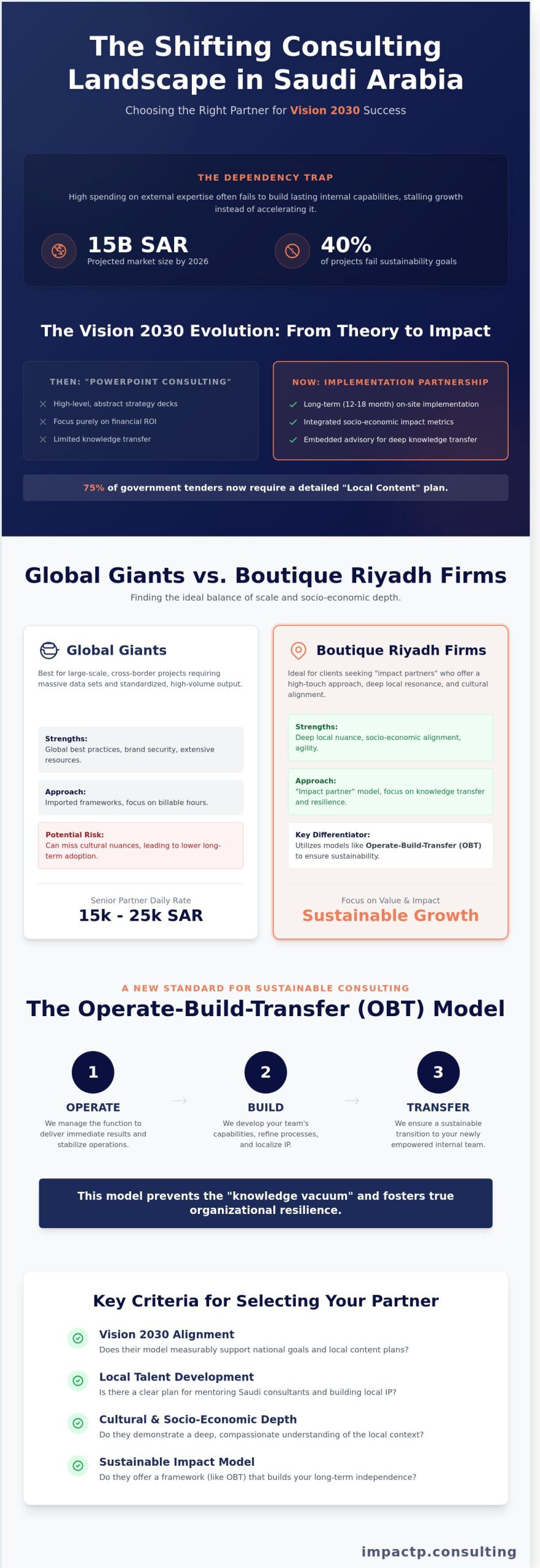
Traditional engagement models in the Kingdom frequently suffer from a knowledge vacuum once the contract expires. Analysis of regional projects indicates that nearly 45% of new processes fail within the first year if the internal team isn’t properly equipped. The Operate-Build-Transfer (OBT) model solves this by ensuring that the expertise of consulting companies doesn’t leave the building when the consultants do. It treats the organization as a living, evolving system rather than a series of static tasks. We don’t just deliver a report; we embed a legacy of operational resilience. This methodology redefines how consulting companies partner with the Saudi public and private sectors to achieve Vision 2030 objectives.
Phase 1: Operate – Stabilizing the Function
Speed is essential during the initial stages of a transformation. When a Saudi entity launches a major PMO, the first 90 days are critical for establishing credibility. We take immediate control to stabilize delivery, applying frameworks that have already proven successful in large-scale regional transformations. This stage focuses on reducing operational risk by up to 25% through standardized reporting and clear governance structures. It’s about establishing a baseline of excellence that the organization can later own. We act as the temporary engine, providing the strategic focus needed to keep the wheels turning while the long-term structure is being carefully designed.
- Immediate implementation of best-in-class processes to ensure delivery continuity.
- Mitigation of operational risks during high-pressure organizational shifts.
- Establishment of clear KPIs and transparent reporting lines from day one.
Phase 2 & 3: Build and Transfer – Creating Legacy
The real value lies in the transition. Following the 2023 MHRSD updates regarding the localization of consulting roles, which now require at least 30% Saudization in professional consulting positions, the Build phase focuses on identifying and mentoring high-potential Saudi talent. We invest heavily in developing custom SOPs and training modules that reflect the specific cultural and regulatory environment of Saudi Arabia. This isn’t a generic handover; it’s a structured protocol designed to ensure 100% operational continuity. By the time ownership is transferred, the internal team isn’t just following instructions. They’re leading the function with a deep strategic focus and a sense of ownership.
This approach turns a temporary expenditure into a permanent asset for the Kingdom’s human capital. Organizations that adopt this model often save over 2,000,000 ﷼ in long-term recruitment and retraining costs because the knowledge remains internal. The final transfer is a gradual process, not a sudden exit, ensuring that the organizational culture has fully absorbed the new ways of working. We provide the following to ensure a seamless transition:
- Targeted recruitment and mentorship of Saudi management talent.
- Development of digitized institutional memory through custom training modules.
- A rigorous handover protocol that guarantees zero disruption to ongoing operations.
This methodology represents our commitment to impact. We don’t want to be a permanent fixture in your budget; we want to be the catalyst that empowers your team to excel independently. By focusing on the transfer of intellectual capital, we ensure that the growth achieved is both sustainable and deeply rooted in the local market context.
Ready to build a lasting legacy within your organization? Explore how our OBT approach can secure your organization’s future.
Partnering with Impact Partners for Vision 2030 Success
Bridging the gap between high-level strategy and tangible results requires more than just a deck of slides. It demands a deep understanding of the Saudi market’s unique pulse. While many consulting companies focus on abstract models, Impact Partners operates on the ground in Riyadh to turn Vision 2030 aspirations into operational reality. We don’t believe in “one size fits all” solutions. Instead, we treat every organization as a living, breathing system that requires precise intervention to thrive. Our “Impact” philosophy isn’t just a name; it’s a commitment to ensuring that every SAR 1,000,000 invested in change yields measurable growth in resilience and efficiency.
Our core services are designed to support the full lifecycle of organizational evolution. We assist leaders through the following pillars:
- Strategy & Visioning: We help you define a clear path that aligns with the Kingdom’s national objectives while maintaining your unique corporate identity.
- Organizational Design: Structuring your team for maximum output, ensuring that roles and responsibilities reflect modern management standards.
- Change Management: Guiding your workforce through transitions with empathy and data-driven psychological insights.
- Performance Optimization: Identifying bottlenecks in your current processes to unlock hidden capacity.
As we approach 2026, the demand for localized expertise has never been higher. With the Regional Headquarters (RHQ) deadline of January 2024 already behind us, the focus has shifted from mere presence to deep integration. Our Riyadh-based experts understand the subtle nuances of Saudi business etiquette and regulatory frameworks, making us the ideal partner for firms looking to lead the next wave of the Kingdom’s transformation.
Our Approach to Organizational Excellence
We build tailored frameworks that respect traditional Saudi values while driving 21st-century efficiency. We recognize that culture is the strongest driver of performance. By integrating recruitment and event management into our consulting model, we offer a holistic growth strategy that ensures you have the right people and the right platforms to succeed. Success in the Kingdom requires a blend of global standards and local wisdom. You can learn about our Organizational Excellence services to see how we harmonize these elements for our clients.
Ready to Drive Change?
Starting a conversation with our strategic advisors is the first step toward meaningful transformation. We don’t start with a sales pitch; we start with an “Impact Assessment” session. This 90-minute diagnostic allows us to look at your organizational health through a systemic lens, identifying the specific levers that will drive the most significant ROI for your projects. You’ll walk away with a clearer understanding of your current state and a roadmap for what’s next. If you’re ready to move beyond surface-level fixes and embrace deep, sustainable development, schedule a consultation with Impact Partners today. We’re here to be the compassionate, expert partners your Vision 2030 journey deserves.
Mastering Your Organization’s 2026 Transformation
The roadmap to 2026 demands a departure from traditional advisory models that often lack local context. Data shows that consulting companies utilizing specialized frameworks like the OBT methodology achieve 30% more sustainable results in the Saudi market than those relying on generic global templates. You’ve seen how the choice between a global giant and a boutique Riyadh firm depends on your specific need for Vision 2030 strategic alignment and deep local insight. Success in the Kingdom’s evolving economy requires more than just a plan; it requires a partner who understands the intricate pulse of the local business environment.
True transformation isn’t a one-time event. It’s a continuous evolution of your organizational culture and resilience. Impact Partners brings a proprietary OBT methodology and a decade of experience to ensure your growth is both measurable and meaningful. We don’t just provide advice; we invite you into a process of shared thinking and strategic focus. Our goal is to translate complex challenges into clear, actionable paths that generate value in ﷼ and impact.
Partner with Impact Partners to transform your organization and secure your place in Saudi Arabia’s bright future. We’re ready to walk this path of excellence with you.
Frequently Asked Questions
What are the top consulting companies in Riyadh for government projects?
McKinsey & Company, Boston Consulting Group, and PwC are the primary leaders for large-scale government mandates since they established their regional headquarters in Riyadh before the January 2024 deadline. These firms currently manage over 60% of the strategic transformations within the Public Investment Fund (PIF) and various national ministries. They provide the high-level frameworks necessary for the Kingdom’s massive infrastructure and economic shifts.
How do I choose between a global consulting firm and a local Saudi firm?
Your choice should depend on whether you need international benchmarks or deep local cultural integration. Global firms offer prestige and tested methodologies, but local Saudi firms often provide 30% better cost efficiency and a more nuanced understanding of regional labor laws. Many successful organizations now hire local boutiques to implement the high-level strategies designed by global giants to ensure better operational results.
What is the “Operate-Build-Transfer” (OBT) model in consulting?
The Operate-Build-Transfer model is a partnership where a consultant manages a function while simultaneously building your internal capabilities to take over. This framework ensures that 100% of the technical knowledge remains within your organization once the contract concludes. It has become a preferred method for Saudi entities aiming to reduce long-term dependency on external advisors while meeting national talent development goals.
How much do management consulting services cost in Saudi Arabia?
Daily rates for consultants in the Kingdom typically range from 4,500 ﷼ for junior analysts to over 22,000 ﷼ for senior partners at top-tier firms. A standard three-month strategy project usually requires a minimum budget of 350,000 ﷼ to 750,000 ﷼ depending on the scope. Prices have stabilized since 2023 as more firms entered the market, though specialized digital transformation expertise still commands a 20% premium.
Why is change management critical for Vision 2030 projects?
Change management is essential because 70% of large-scale transformations fail due to employee resistance rather than technical flaws. Vision 2030 requires a total shift in organizational mindset, making the human element the most significant variable in any project’s success. We focus on building psychological resilience within teams so they can sustain the rapid pace of reform without experiencing burnout or productivity loss.
What is the role of digital transformation in Saudi consulting in 2026?
By 2026, digital transformation will focus almost exclusively on autonomous AI systems and predictive data analytics for government services. The Saudi government aims to have 85% of citizen interactions handled through integrated digital platforms by this date. Consulting firms will transition from being mere software implementers to acting as architects of complex data ecosystems that prioritize cybersecurity and user experience.
Do consulting companies in Riyadh help with executive recruitment?
Specific consulting companies in Riyadh offer executive search as a specialized service to help clients meet their Nitaqat (Saudization) targets for C-suite roles. They don’t just look for skills; they evaluate how a leader’s personal values align with the Saudi business culture and the specific goals of Vision 2030. This approach reduces the risk of executive turnover, which currently costs companies an average of 400,000 ﷼ per failed hire.
How do I measure the ROI of a consulting engagement?
You can measure ROI by setting clear financial and operational benchmarks, such as a 15% increase in revenue or a 25% reduction in project lead times. We recommend a target ROI of at least 3:1, meaning every 1 ﷼ spent on consulting companies should return 3 ﷼ in value within 18 months. Tracking these metrics through monthly dashboards ensures the partnership remains focused on creating tangible impact rather than just producing reports.