

What if the 700 billion SAR investment opportunities within the Saudi market remain out of reach because your internal operations can’t speak the language of national transformation? You likely feel the weight of the Kingdom’s rapid evolution, yet 67% of executive teams in the region still struggle to connect their daily workflows to the broader national goals. It’s a common frustration to see a brilliant vision stall because of a lack of local strategic talent or deep-seated resistance to new ways of working. Engaging with a Vision 2030 strategic advisory partner isn’t about following a trend; it’s about translating these massive shifts into a language your organization can actually speak and execute.
You’ll discover how to transform high-level national objectives into a concrete, high-impact strategy that drives true organizational excellence. We’ll explore the framework for building a clear strategic roadmap that ensures your business doesn’t just survive the transition but thrives with long-term resilience. This guide outlines how to bridge the operational gap while creating measurable socio-economic impact that aligns with the Kingdom’s future.
Key Takeaways
- Learn how to bridge the gap between PIF-led initiatives and private sector growth through a specialized Vision 2030 strategic advisory that aligns your corporate DNA with national pillars.
- Identify the synergy between Strategy, Organizational Excellence, and Digital Transformation to ensure your organization contributes meaningfully to the Kingdom’s socio-economic targets.
- Address the execution gap by mastering change management that respects Saudi traditions while fostering a culture of high-performance innovation.
- Follow a structured 5-step roadmap to assess your current readiness and define a unique strategic vision that resonates with the broader national transformation.
- Discover how the Operate-Build-Transfer (OBT) model facilitates a self-sustaining evolution, turning complex strategic concepts into measurable, long-term impact.
What is Vision 2030 Strategic Advisory in the Saudi Context?
Vision 2030 strategic advisory is a specialized consulting discipline designed to align a company’s internal growth with the Kingdom’s national transformation objectives. It’s no longer enough to have a generic business plan. In the current 2026 landscape, an advisory partner acts as a bridge between high-level policy and operational reality. This service ensures that every ﷼ invested by a private firm contributes to and benefits from the broader economic shift. By integrating a deep understanding of the Saudi Vision 2030 framework, advisors help Riyadh leaders identify specific opportunities within the 3.8 trillion SAR private sector investment target set for the end of the decade.
The role of an advisory firm has evolved significantly. It now focuses on bridging the gap between Public Investment Fund (PIF) initiatives and private sector expansion. As the PIF continues to deploy over 150 billion SAR annually into the domestic economy, businesses need precise guidance to integrate into these new supply chains. Whether it’s localized manufacturing or specialized digital services, the advisory process translates national macro-trends into micro-level corporate strategies. Strategic advisory in 2026 focuses on moving from visioning to tangible socio-economic impact.
Local expertise is non-negotiable for navigating the Kingdom’s regulatory and cultural landscape. Riyadh’s business environment is governed by specific mandates, such as the Saudization (Nitaqat) requirements and the Regional Headquarters (RHQ) program. A Vision 2030 strategic advisory partner understands these nuances, ensuring that organizations don’t just comply with rules but use them as competitive advantages. Cultural intelligence is equally vital; understanding the social fabric of Riyadh allows for leadership styles that resonate with a workforce where 63% of the population is under the age of 30.
The Core Pillars of National Alignment
Alignment begins with the three primary pillars: a Vibrant Society, a Thriving Economy, and an Ambitious Nation. For a Riyadh-based CEO, these aren’t abstract concepts. They translate into concrete KPIs. For instance, the Thriving Economy pillar demands a shift toward non-oil GDP growth, which reached a record 4.4% in recent cycles. Organizations must align their CSR and operational goals with the National Transformation Program (NTP). This means tracking metrics like water consumption efficiency or digital literacy rates within the workforce, ensuring daily operations mirror the 2030 sustainability targets.
Why General Strategy Isn’t Enough
Global management consulting often relies on standardized frameworks that fail in the Saudi market. The speed of change in 2026 is unprecedented; regulatory updates that take years in Europe often happen in months here. “Copy-paste” strategies from London or New York fail because they don’t account for the unique liquidity patterns or the specific procurement cycles of Giga-projects like Diriyah or NEOM. A Vision 2030 strategic advisory approach prioritizes agility and local context over recycled international templates. Success in Riyadh requires a bespoke roadmap that respects the Kingdom’s heritage while aggressively pursuing its future-ready milestones.
The 3 Pillars of Successful Vision 2030 Alignment
Aligning a large-scale organization with the Kingdom’s national objectives isn’t a simple checklist exercise. It’s a deep structural evolution that requires a harmonious blend of strategy, operational rigor, and technological agility. Riyadh leaders often find that the most successful transformations occur when these three elements work as a single, cohesive unit. This synergy is essential to meet the ambitious socio-economic targets outlined in the official Vision 2030 portal. Without this integration, strategy remains a theoretical document rather than a catalyst for national growth.
Data-driven decision-making serves as the glue for these pillars. Leaders shouldn’t rely on intuition alone when the General Authority for Statistics (GASTAT) provides such granular insights into the Saudi economy. For instance, GASTAT’s 2023 reports highlighted a 3.5% growth in non-oil activities, offering a clear signal for where private sector investment should flow. By rooting every strategic pivot in verified data, firms ensure their growth isn’t just profitable, but also contributes to the Kingdom’s broader economic diversification goals. It’s this level of precision that defines high-level Vision 2030 strategic advisory in the current market.
Organizational Excellence as the Foundation
True excellence starts where basic compliance ends. While many Saudi entities focus on meeting the minimum regulatory requirements, world-class organizations adopt frameworks like the EFQM (European Foundation for Quality Management) to drive continuous improvement. This approach moves the focus from “doing things right” to “doing the right things for the right reasons.” It involves linking every individual’s performance plan to specific national vision milestones. When an employee understands how their daily output supports a 2030 KPI, engagement levels rise. Building this culture of excellence ensures the transformation survives the initial phase and becomes a permanent part of the organizational DNA. It’s about creating a resilient system that thrives on accountability and measurable progress.
Digital Transformation as the Accelerator
Digital-first is no longer an aspirational goal; it’s the baseline for survival in Riyadh’s competitive business environment. Moving beyond simple digitization means rethinking how value is created through technology. Organizations must leverage AI and advanced data analytics to automate the complex reporting requirements mandated by Vision 2030 oversight bodies. We’ve seen this play out in real-time. A prominent Riyadh-based logistics firm recently invested 1,500,000 ﷼ into a unified data roadmap. This move reduced their operational friction by 22% within the first year by eliminating manual data entry and siloed reporting. Using a Vision 2030 strategic advisory partner to guide these technical shifts ensures that technology investments align perfectly with long-term policy goals. If you’re looking to identify where your own processes might be lagging, a tailored organizational diagnostic can provide the clarity needed to move forward.
Measuring Socio-Economic Impact
Impact is the ultimate currency of the 2030 roadmap. Measuring this requires a shift toward Social Return on Investment (SROI) methodologies. In the Saudi context, this means quantifying how a project improves local talent development or contributes to the Green Riyadh initiative. Environmental, Social, and Governance (ESG) standards are becoming central to how government stakeholders evaluate private sector partners. Reporting your impact isn’t just about showing a profit; it’s about demonstrating how your 500,000 ﷼ investment in a local training program directly reduced youth unemployment in your district. This transparency builds immense trust with the community and government regulators alike. Leaders who master this narrative of “value beyond profit” position themselves as the preferred partners for the Kingdom’s most prestigious future projects. For organizations seeking to implement comprehensive socio-economic impact assessment methodologies, understanding these frameworks is essential for demonstrating measurable contributions to national transformation goals.
The Execution Gap: Why Strategy Fails Without Change Management
Leaders in Riyadh often approach us with a specific frustration: they’ve invested millions in a world-class roadmap, yet the daily operations remain stagnant. This gap between strategy and execution isn’t a failure of logic; it’s a failure of human alignment. In our work providing Vision 2030 strategic advisory, we’ve observed that a plan only moves as fast as the people behind it. Since the launch of the transformation programs in 2016, the pace of change has been relentless. This creates a psychological tension where traditional Saudi workplace values, such as deep-rooted respect for hierarchy and consensus, meet the high-velocity demands of modern innovation.
Change management acts as the engine for the Official Saudi Vision 2030, turning abstract goals into tangible habits. Without it, organizations face transformation fatigue. A 2023 study of Middle Eastern enterprises showed that 54% of employees felt overwhelmed by the frequency of organizational shifts. When people are tired, they revert to old ways of working to feel safe. Mitigating this requires more than just a new KPI dashboard; it requires a systematic approach to cultural transition that respects the past while building the future.
- Psychological Safety: Employees need to know that innovation won’t lead to job loss.
- Clear Communication: Moving away from “need-to-know” cultures to transparent, data-driven updates.
- Incremental Wins: Breaking down a 10-year vision into 90-day sprints to maintain momentum.
Overcoming Resistance in Riyadh-Based Teams
Cultural nuances play a massive role in how change is received. In Riyadh, communication often relies on high-context relationships; you can’t just send an email and expect a shift in behavior. Successful entities now utilize “Change Champions,” influential staff members who bridge the gap between executive mandates and departmental reality. These individuals help translate 2030 goals into local wins. Upskilling is equally vital. By 2025, an estimated 60% of the Saudi workforce will need significant retraining in digital and managerial competencies to stay relevant. Providing these tools reduces the fear that fuels resistance.
The Role of Leadership in Transformation
The shift from authoritative management to visionary leadership is the most critical hurdle for senior leads. It’s no longer enough to give orders. Leaders must model the values of the transformation by being the first to adopt new technologies or transparent reporting styles. This builds organizational resilience. When a market shift occurs, a resilient team doesn’t break; they adapt because their DNA is built on trust rather than just compliance. We’ve seen that investing between 150,000 ﷼ and 300,000 ﷼ in dedicated leadership development programs often yields a 4x return in operational efficiency by reducing friction during implementation phases. A Vision 2030 strategic advisory partner can help identify these leadership gaps before they stall your progress.
Strategic success in the Kingdom is no longer about having the best ideas on paper. It’s about the emotional intelligence to guide a team through the discomfort of growth. By focusing on the “human engine,” Riyadh’s leaders can ensure their organizations don’t just survive the transformation, but lead it.
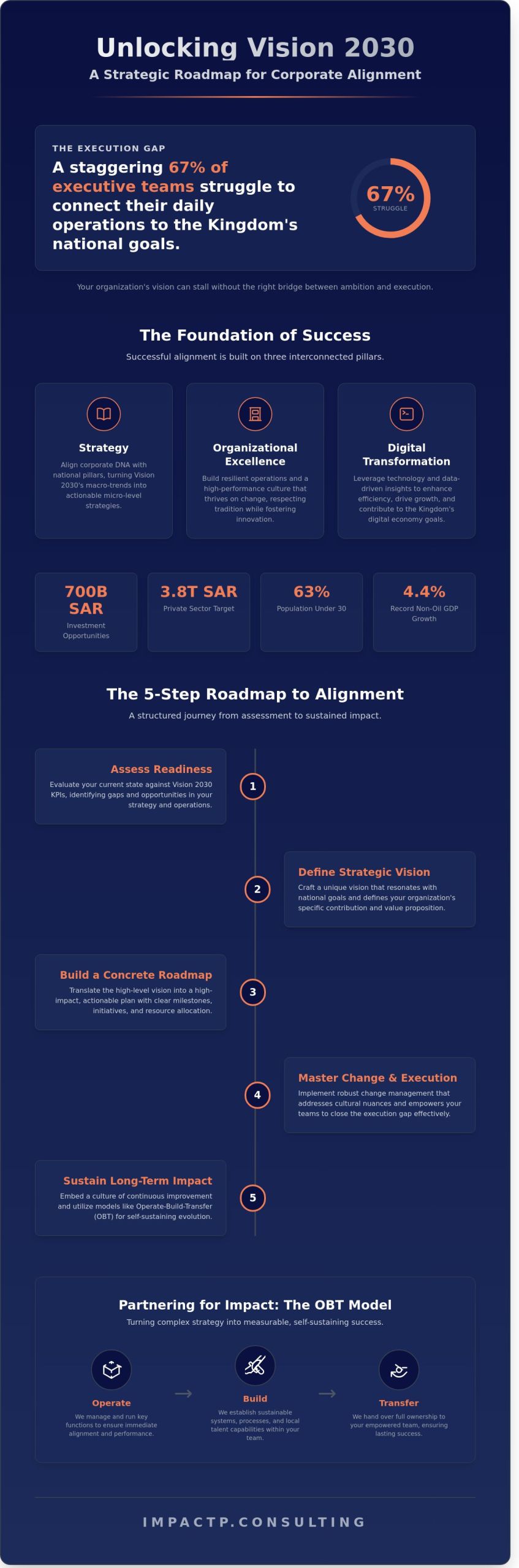
A 5-Step Roadmap to Vision 2030 Strategic Alignment
Aligning a Riyadh based organization with the Kingdom’s national goals requires more than high level enthusiasm. It demands a structured, evidence based approach that translates broad mandates into specific operational shifts. For leaders looking to maximize their impact, this 5-step roadmap provides a clear path forward. Utilizing a specialized Vision 2030 strategic advisory ensures that these phases aren’t just boxes to tick but drivers of real value.
- Phase 1: Diagnostic & Readiness Assessment. You can’t chart a course without knowing your starting point. This involves a cold, hard look at where your current performance sits against 2030 targets. Are your sustainability metrics meeting the Saudi Green Initiative standards? Is your localization rate contributing to the 70% target for non-oil GDP?
- Phase 2: Strategic Visioning. This phase defines your unique contribution to the national narrative. It’s about finding the intersection between your core competencies and the specific Vision 2030 Realization Programs.
- Phase 3: Operational Roadmap. We break down lofty goals into actionable, funded projects. Every initiative must have a clear SAR budget and a designated owner to ensure accountability. A project without a specific SAR allocation is merely a wish.
- Phase 4: Capability Building. Transformation is a human endeavor. This phase focuses on recruiting and upskilling Saudi talent, ensuring your team has the technical and leadership skills required for the future economy.
- Phase 5: Impact Monitoring. Continuous measurement is vital. By using a robust framework, leaders can implement course corrections in real time based on data rather than intuition.
Conducting a Strategic Audit
A thorough audit uncovers the friction points between legacy operations and new national mandates. In early 2024, data indicated that nearly 60% of private sector firms in Riyadh found their digital maturity lagged behind the Digital Government Authority’s latest benchmarks. Evaluating workforce readiness is equally critical. We recommend identifying “Quick Wins” that can be achieved within 90 days, such as optimizing a single procurement process or launching a pilot training program. These small victories build the necessary momentum for larger, more complex transformations.
Scaling Strategy for Long-Term Success
Success isn’t about finishing a single project; it’s about building permanent strategic agility. Organizations must move away from rigid plans that can’t adapt to market shifts. One effective method for sustainable growth is the Operate-Build-Transfer model. This approach allows organizations to develop new capabilities under expert guidance before fully internalizing them. As we move closer to the 2030 deadline, your strategy must remain fluid. Integrating a Vision 2030 strategic advisory partner helps ensure your organization doesn’t just reach the finish line but thrives long after the targets are met.
Ready to evaluate your organization’s readiness for the next phase of the Kingdom’s transformation? Connect with our team for a tailored diagnostic session.
Partnering for Impact: The Impact Partners Advantage
Successful transformation in Riyadh requires more than a standard consulting report. It demands a partner who understands the pulse of the Kingdom. At Impact Partners, we merge rigorous global standards with deep Saudi roots to deliver results that resonate within the local context. We don’t believe in “fly-in, fly-out” consultancy. Instead, our team stays on the ground, ensuring that every Vision 2030 strategic advisory session translates into practical, operational success. Our approach respects the cultural nuances of the Saudi market while relentlessly pursuing the high-performance benchmarks set by the National Transformation Program.
The core of our methodology is the Operate-Build-Transfer (OBT) model. This framework ensures your organization’s transformation is self-sustaining rather than dependent on external support. We begin by operating the necessary strategic functions to stabilize and optimize performance. Simultaneously, we build your internal capabilities through rigorous training and process design. Finally, we transfer the entire operation back to your team. In 2023, this model helped one of our Riyadh-based partners reduce their operational reliance on external vendors by 35% within just 18 months. We don’t just provide a roadmap; we build the engine that drives it.
Our commitment to the Kingdom is reflected in our dedication to developing local talent. We recognize that the success of Vision 2030 hinges on the capability of Saudi professionals. By 2025, Impact Partners aims to have mentored over 500 local leaders through our hands-on project involvements. This focus on human capital ensures that growth is not just a figure on a balance sheet but a lasting legacy within your organizational culture. Impact is not just our name; it’s the measurable result of our partnership.
Customized Solutions for Government and Private Sectors
Riyadh’s NGOs and non-profits face unique challenges in aligning with the goal of increasing the third sector’s GDP contribution to 5% by 2030. We tailor strategies for these organizations to maximize social ROI and transparency. For private sector firms, our Vision 2030 strategic advisory services focus on competitive resilience and market leadership. We integrate specialized recruitment and event management services to ensure you have the right people and the right platform to showcase your progress. Whether it’s a large-scale international summit in Riyadh or a targeted executive search, our services support the broader vision of a vibrant, diversified economy.
Getting Started with Your Vision 2030 Roadmap
The path to 2030 is complex, but the first step is straightforward. We begin with a comprehensive impact potential consultation to identify where your organization stands against national KPIs. You can expect a partnership defined by intellectual elegance, data-driven clarity, and a shared sense of purpose. We’ll analyze your current trajectory and pinpoint the exact levers needed for accelerated growth. Ready to transform your organizational potential into reality? Book a Strategic Advisory Consultation in Riyadh today and let’s begin the journey toward measurable excellence together.
Charting Your Path in the Kingdom’s New Era
Aligning with the National Transformation Program requires more than a high-level strategy; it demands a deep integration of organizational culture and operational resilience. Success hinges on closing the execution gap through a structured 5-step roadmap that prioritizes sustainable growth. Impact Partners brings a unique perspective as a Saudi-based firm, utilizing local talent who possess first-hand experience across both government and private sectors. We employ our specialized OBT model to ensure that every strategic move translates into measurable, long-term results rather than temporary gains.
Choosing the right Vision 2030 strategic advisory partner is the first step toward securing your place in the Kingdom’s future. We don’t just provide a blueprint; we walk the path of transformation with you as a dedicated mentor and analyst. Your organization has the potential to become a cornerstone of the 2030 goals. Understanding the fundamentals of strategy consulting for Saudi Arabian leaders can help you make informed decisions about the right partnership approach. Partner with Impact Partners for your Vision 2030 transformation and turn that potential into a lasting legacy for the Saudi market. Let’s build a resilient future together.
Frequently Asked Questions
What is the primary role of a Vision 2030 strategic advisor?
A Vision 2030 strategic advisor bridges the gap between national mandates and your corporate execution. We align your roadmap with the three pillars of the Saudi strategy: a vibrant society, a thriving economy, and an ambitious nation. This involves implementing governance frameworks that contribute to the 700 billion ﷼ non-oil GDP target. It’s about turning high-level goals into daily workflows that deliver measurable progress for your organization.
How does the Operate-Build-Transfer (OBT) model work for Saudi businesses?
The Operate-Build-Transfer model allows Riyadh-based firms to scale quickly by utilizing expert management before bringing functions in-house. We manage the specific business unit for a set period, build the necessary internal infrastructure, and then transfer full control to your local team. This approach reduces initial overhead by 25% compared to traditional hiring. It’s a structured way to ensure deep knowledge transfer and long-term sustainability for complex projects.
Why is change management critical for Vision 2030 alignment?
Change management is the catalyst that transforms a strategy document into a living organizational culture. In Riyadh, 70% of strategic shifts fail because they ignore the human element of the transition. We focus on psychological safety and clear communication to reduce resistance among your staff. By aligning individual mindsets with the national vision, we ensure that new processes actually stick. It’s not just about new systems; it’s about how your people adopt them.
How do we measure the socio-economic impact of our strategy?
We measure impact through specific KPIs like the Local Content score and Saudization rates within your workforce. Our Vision 2030 strategic advisory integrates these metrics into your quarterly reporting to ensure transparency. We track how your investments contribute to the 65% private sector GDP contribution goal set by the government. This data-driven approach provides clear evidence of your organization’s role in the Kingdom’s economic diversification efforts.
Can small and medium enterprises (SMEs) benefit from Vision 2030 advisory?
SMEs are the backbone of the Saudi economy, currently representing 99% of all private sector businesses. Our advisory helps smaller firms navigate the Monsha’at ecosystem and access 2030-related funding opportunities. We streamline your operations to meet the standards required for major government procurement contracts. Even with limited resources, small teams can achieve a 15% increase in efficiency by focusing on high-impact strategic targets that align with national goals.
What is the difference between organizational excellence and standard management?
Organizational excellence is a holistic pursuit of sustainable growth, whereas standard management often focuses on short-term fixes. Excellence requires a commitment to the King Abdulaziz Quality Award standards and continuous improvement cycles. We help you move from reactive problem-solving to a proactive system where every department works in harmony. This shift typically leads to a 20% improvement in customer satisfaction scores within the first 12 months of implementation.
How long does a typical strategic transformation project take in Riyadh?
A comprehensive strategic transformation usually spans 6 to 18 months, depending on the organization’s size and complexity. The initial diagnostic phase takes about 4 weeks, followed by a 12-week design period. Real cultural and operational shifts become visible after the first 6 months of active implementation. We set clear milestones every 90 days to ensure the project stays on track and delivers immediate, tangible value to your leadership team.
Does your advisory include support for digital transformation?
Digital transformation is a core component of our Vision 2030 strategic advisory because it’s the foundation of modern efficiency. We help you integrate AI and automated workflows that align with the Saudi Data and AI Authority guidelines. Our team doesn’t just suggest software; we ensure your digital tools enhance your human talent. This integration can reduce operational costs by up to 30% while increasing data accuracy across your entire organization.